
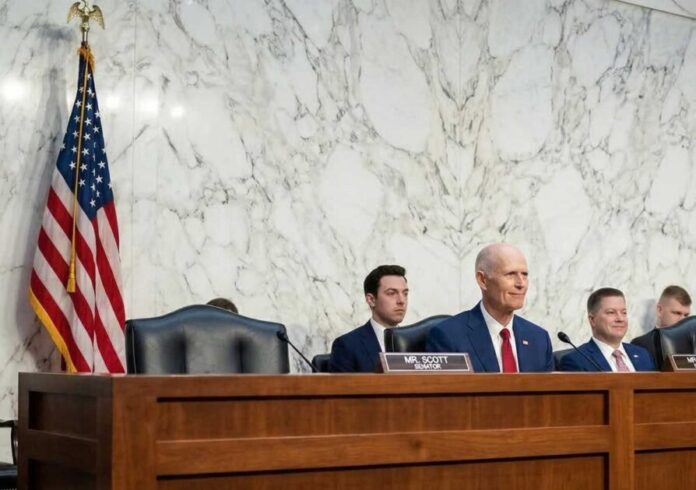
WASHINGTON, D.C. — Senate Committee on Aging Chairman Sen. Rick Scott (R-Fla.) sent a formal letter on March 19 to Health and Human Services Secretary Robert Kennedy Jr., FDA Commissioner Martin Makary, and NIH Director Jay Bhattacharya, demanding a comprehensive review of Chinese Communist Party-linked entities operating inside the US clinical trial and drug approval pipeline, according to the letter shared with The Epoch Times ahead of publication.
Scott specifically flagged Bioheng — a China-based clinical-stage company also known as Imviva — as being “reportedly financed by CCP-linked sources,” and called on agencies to re-examine the company’s Regenerative Medicine Advanced Therapy (RMAT) designation, a coveted FDA status that accelerates a drug’s path to US market approval.
FDA Still Accepts Data From Uninspected China Sites
What makes Scott’s letter particularly pointed is not just the politics — it’s a specific regulatory gap the FDA has yet to close. The Food and Drug Administration currently permits drug companies to submit data from Chinese clinical trial sites that US inspectors have never physically visited, allowing those applications to advance through the approval pipeline, according to a March 18 opening statement by House Select Committee on China Chairman John Moolenaar, reviewed by this publication.
That policy becomes harder to defend in light of what Moolenaar also confirmed: studies show more than 60 percent of patients enrolled in Chinese clinical trials were started on treatment before being told their diagnosis. Trials have also taken place at People’s Liberation Army military hospitals and in Xinjiang, where the CCP has documented history of coercing ethnic minorities into medical studies. None of this disqualifies the data under current FDA rules.
Who Bears the Immediate Risk
The concern cuts across multiple patient populations in the United States:
- Americans taking generic medications for blood pressure, diabetes, infections, and blood clots — roughly 90 percent of all US prescriptions run through Chinese-controlled active pharmaceutical ingredients
- Patients enrolled in or awaiting novel biologics and cancer therapies sourced from Chinese biotech development pipelines
- US military personnel and veterans, identified by Moolenaar as among the first populations to face shortages if China restricts pharmaceutical ingredient exports
Scott’s letter requests a written response from each agency within 60 days.
The Angle Other Outlets Aren’t Leading With
The real story isn’t the letter itself — it’s the Bioheng RMAT designation. Documents reviewed by this publication show Scott is asking HHS, the FDA, and NIH to evaluate whether that specific designation should be revoked or suspended pending national security review. An RMAT designation fast-tracks manufacturing and regulatory meetings for a therapy and can dramatically shorten the time before a Chinese-developed product reaches American patients. No outlet covering this story as of March 19 has placed that specific demand at the center of their reporting.
Tennessee Is the Last Line on Antibiotics
The geographic reality of US pharmaceutical dependency sharpens when you look at what’s left domestically. USAntibiotics, based in Tennessee, is now the only remaining American manufacturer of amoxicillin — one of the most commonly prescribed antibiotics in the country — according to Moolenaar’s March 18 statement before the Select Committee.
For heparin, the blood thinner used in surgical procedures across every major US hospital, virtually all global processing now occurs inside China. According to research from Washington University in St. Louis, 83 of the top 100 generic drugs used by Americans have no domestic source for their key chemical ingredients.
A Pipeline Shift That Happened Fast
The speed of China‘s move into high-value drug development is the detail that congressional investigators say catches most Americans off guard. In 2020, essentially zero percent of major global pharmaceutical licensing deals involved molecules developed by Chinese biotech firms. By 2025, that figure had reached 48 percent, according to data cited by Moolenaar at the March 18 Select Committee hearing.
US pharmaceutical companies — facing a wave of patent expirations on their most profitable existing drugs — are increasingly licensing Chinese-origin molecules to fill their pipelines. The result, Moolenaar argued, is a self-reinforcing cycle: as early-stage trials migrate to China, the infrastructure, trained researchers, and investment capital follow, leaving fewer operational trial sites inside the United States.
Scott’s Push Builds on a Weeks-Long Campaign
This isn’t Scott’s first move on the issue in recent weeks. On March 11, he chaired a Senate hearing titled “Foreign Dependence: How China Captured America’s Drug Supply”. He has also proposed the bipartisan CLEAR LABELS Act, which would require pharmaceutical products to identify Chinese origin on labels — a measure that has not yet advanced to a floor vote.
What Scott cannot do unilaterally is force the FDA to change its inspection policies or revoke a company’s RMAT designation. His letter is a formal request, not legislation. Whether Kennedy, Makary, or Bhattacharya respond within the requested 60-day window — or respond substantively at all — remains an open question. Officials at HHS and the FDA had not issued public responses to Scott’s letter as of the time of this reporting.
