
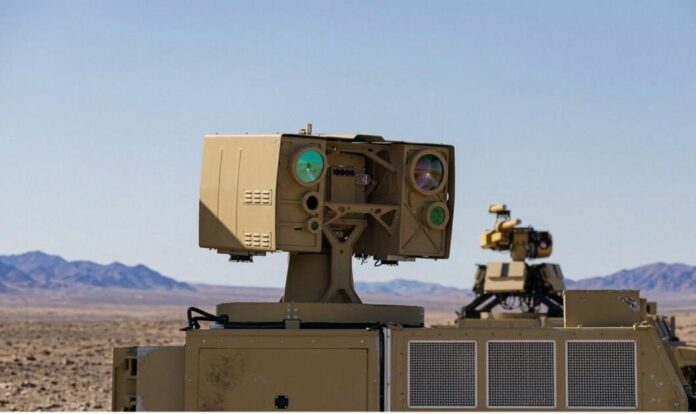
WASHINGTON, D.C. – The U.S. military is rapidly deploying directed-energy weapons to destroy incoming Iranian drones this week across the Middle East, according to U.S. Central Command, drastically cutting the cost of aerial interception from $3 million to $3.50 per shot.
Commanders previously relied on Patriot PAC-3 missiles to eliminate $30,000 Shahed drones, creating an unsustainable financial drain. Defense budget documents examined by reporters reveal the pivot to laser defense will immediately save the Pentagon millions daily, as localized conflicts threaten to deplete conventional munition stockpiles by late 2026.
The tactical shift directly impacts thousands of U.S. service members stationed at forward operating bases in Iraq and aboard naval vessels in the Persian Gulf. Financial ripple effects extend to defense contractors, specifically Virginia-based AeroVironment, which manufactures the 20-kilowatt LOCUST system currently engaging active targets.
Despite the dramatic cost savings, combat reports reviewed by this publication show the highly touted lasers remain critically vulnerable to environmental factors. Silt, heavy rain, and sandstorms common in the region scatter the focused light beams, rendering the weapons ineffective and forcing base commanders to maintain expensive conventional missiles as primary backups.
Why US Laser Weapons Fail During Desert Sandstorms
Domestic testing in Texas has already exposed severe operational friction. When the U.S. Army deployed the laser near El Paso International Airport in February to counter cartel surveillance, a coordination breakdown with the Federal Aviation Administration triggered a seven-hour commercial airspace shutdown.
The system also suffers from target identification flaws in crowded airspace. According to an incident report, the laser automatically engaged and destroyed a Customs and Border Protection drone in a friendly-fire incident near Fort Hancock, prompting four months of expanded airspace restrictions along the southern border.
AeroVironment publicly highlighted the logistical advantage of their systems on social media following a CBS “60 Minutes” broadcast on Sunday.
The ability to fire continuously without waiting for resupply ships fundamentally alters base defense strategies.
“Lasers confront the laws of physics wherever they operate,” defense author Jared Keller said.
$3 Million Missile Costs Drive Urgent US Navy Strategy
The arithmetic of the current conflict forces a stark economic choice for military planners:
| Weapon System | Cost Per Shot | Ammunition Capacity |
|---|---|---|
| Patriot PAC-3 | $3 million | Limited by magazine size |
| Iranian Shahed Drone | $30,000 | Mass swarm capability |
| LOCUST Laser | $3.50 | Unlimited with generator power |
The current deployment covers two primary platforms:
- Land-based 20-kilowatt LOCUST systems protecting static infrastructure
- High-energy HELIOS shipborne platforms guarding naval assets
- Upgraded 50-kilowatt variants testing at forward operating bases
The U.S. Navy integrated the HELIOS system aboard a destroyer during Operation Epic Fury, actively engaging incoming hostile drones over open water where humidity presents different atmospheric challenges than desert dust.
The Pentagon plans to deploy additional upgraded 50-kilowatt variants to Iraqi bases by May. Commanders will evaluate the weather durability of these newer systems during the upcoming summer sandstorm season before approving wider distribution across the theater.
