
WASHINGTON — The U.S. military and allied NATO forces concluded comprehensive high-north training operations on March 13, exposing significant mechanical vulnerabilities across Alaska, Greenland, and Norway as extreme cold damaged aircraft and slowed combat reactions.
The convergence of these massive drills was designed to project power against Russian and Chinese activity in the region. But operational reports reveal the environment itself proved to be the primary threat, with standard procedures resulting in cracked aircraft windows, frozen hydraulic systems, and severe logistics delays for the deployed troops.
The training spanned multiple coordinated efforts, embedding troops from the United States, Canada, and Denmark directly onto the Greenland ice sheet for the first time. The operations required immediate adaptation from interagency partners, including the FBI, the U.S. Coast Guard, and local Alaska Native communities.
Operational assessments and debriefing documents reviewed by this publication indicate that the extreme sub-zero temperatures fundamentally degraded both human and machine capabilities. Service members routinely damaged their own aircraft by opening windows too quickly in the freezing environment or failing to properly warm up critical hydraulic systems before flight, according to U.S. Air Force Lt. Gen. Robert Davis, head of Alaska Command.
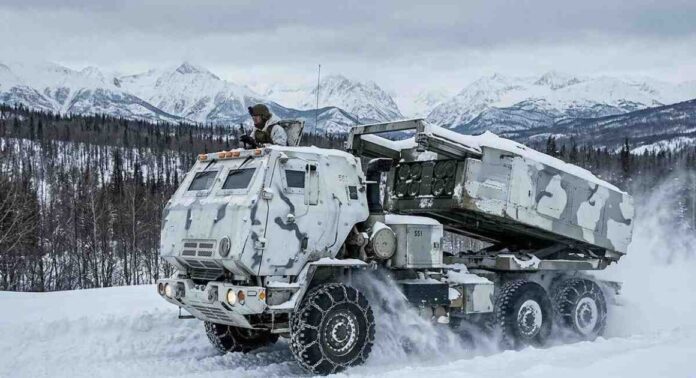
In Setermoen, positioned more than 150 miles above the Arctic Circle, the cold forced a complete logistical overhaul. Marines discovered that every single operational vehicle required snow chains to move, rather than just a designated few, heavily complicating their mobility timelines.
Severe Weather Forces US Marines To Alter Tactics
“Half of the battle in exercising in the wintertime in the Arctic is simply surviving,” Royal Canadian Air Force Lt. Gen. Iain Huddleston, deputy commander of NORAD, said.
The harsh conditions frequently grounded air support, forcing ground troops to rely entirely on mobile artillery. To compensate for blizzard conditions that blinded aircraft, troops with the 2nd Battalion, 10th Marine Regiment deployed HIMARS rocket launchers to fill the critical fire-support gap.
Aircraft cannot always navigate low-visibility environments, First Lt. Landon Foster, a HIMARS platoon commander, noted.
“Human reactions are slower; machine reactions are slower,” Col. William Soucie, commanding officer of the 10th Marine Regiment, stated. He added that navigating the electromagnetic spectrum becomes distinctly more challenging in the frozen environment.
The interconnected military operations tested different strategic requirements across the High North:
| Operation Name | Lead Authority | Location Focus |
|---|---|---|
| Arctic Edge 2026 | NORAD / U.S. Northern Command | Alaska, Greenland |
| Cold Response 2026 | Norway / NATO | Setermoen, Norway |
| Arctic Endurance | Denmark | Greenland (Year-long) |
Russian Base Expansion Drives NATO Arctic Sentry Response
The heightened military focus on the High North follows Russia quietly reopening several of its Cold War-era military bases. The strategic exercises also took place amid President Donald Trump renewing his push to acquire Greenland, an autonomous territory of Denmark.
Following weeks of deliberation over the political rhetoric and shifting power dynamics, NATO launched Arctic Sentry in February to tie together all allied activities in the region, as detailed in official alliance framework documents.
To secure the region, training objectives focused on three critical defensive layers:
- Cruise missile defense against over-the-horizon threats
- Counter-drone operations in low-visibility environments
- Protection of critical civilian infrastructure, including power grids and oil refineries
With Arctic Edge 2026 officially concluded, allied forces are now analyzing the equipment failure data. Meanwhile, Denmark continues to lead Operation Arctic Endurance, keeping a multinational troop presence active in the region throughout the remainder of the year.
