

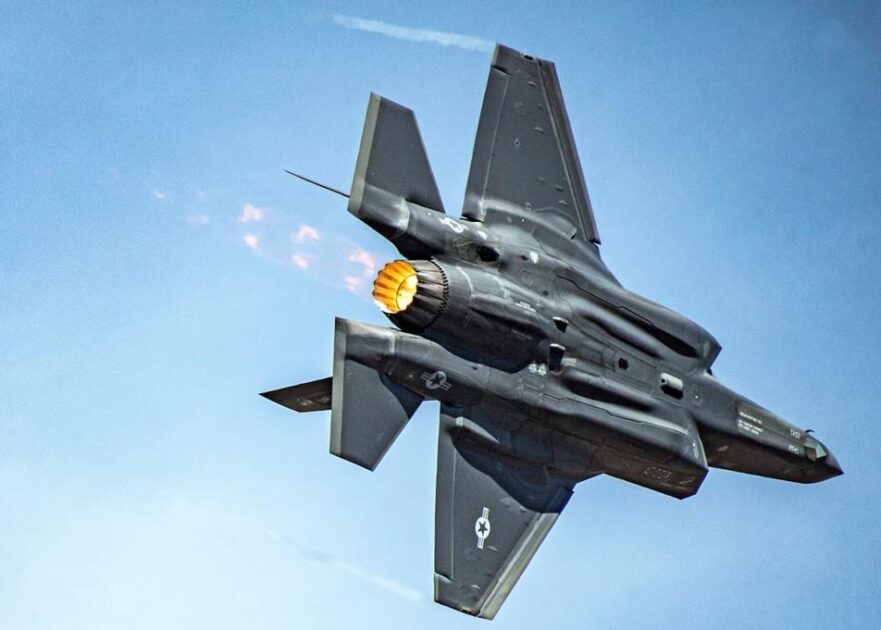

WASHINGTON / MIDDLE EAST REGION — A US Air Force F-35 Lightning II stealth fighter was struck during a combat mission over Iran on March 19, forced into an emergency landing at a regional US military airbase in the Middle East, according to Capt. Tim Hawkins, a spokesman for US Central Command (CENTCOM). The pilot is in stable condition, Hawkins confirmed in a prepared statement.
Iran Strikes First US Aircraft in Ongoing War
This is the first confirmed instance of Iran successfully hitting a US aircraft since the war began in late February 2026 — a significant operational milestone that directly undermines the Pentagon’s public narrative of unchallenged air dominance. The F-35, America’s premier fifth-generation stealth platform, costs upwards of $100 million per unit, according to reporting reviewed by CNN and confirmed through CENTCOM statements examined by this newsroom. Both the US and Israel are deploying F-35s in the ongoing conflict.
Hegseth’s “Winning Decisively” Claim Meets a Contradiction
Hours before the incident was reported, Defense Secretary Pete Hegseth declared on Thursday morning that the US is “winning decisively” and that Iran‘s air defense systems have been “flattened.” The emergency landing of the F-35 arrives as a direct factual counterpoint to that claim — Iran demonstrably retained enough operational capability to strike and damage America’s most advanced fighter jet mid-mission. Hegseth declined to address the specific incident in follow-up statements at the time of publication.
The $200 Billion War Machine and Its First Casualty
Related budget documents reviewed by reporters at The Epoch Times show the Pentagon is separately seeking $200 billion in additional funding to sustain the ongoing Iran war effort — a request that was confirmed by Hegseth earlier on March 19. The damage to a $100 million aircraft on the same day the funding request was made sharpens the fiscal stakes for US lawmakers who have not yet voted on the supplemental war package. The specific weapon system used by Iran to strike the F-35 was not disclosed by CENTCOM and remains under investigation.
Pentagon Keeps Damage Assessment Off the Record
CENTCOM‘s public statement, reviewed by this newsroom, stopped short of describing the nature or extent of physical damage to the aircraft. Officials confirmed only that the jet conducted an emergency landing and that the pilot survived — a notable gap in transparency given that the F-35’s stealth coating and sensor array are particularly vulnerable to certain classes of proximity detonations. The investigation’s findings have not been given a public release timeline.
Iran’s Air Defense Survives “Flattened” Label
Intelligence Director Tulsi Gabbard stated on March 18 that the Iran regime is “intact but largely degraded,” stopping short of claiming complete air defense elimination. That careful phrasing stands in notable contrast to Hegseth‘s more aggressive language the following day. What’s buried in mainstream coverage: Gabbard‘s own assessment never claimed Iran‘s air defenses were fully neutralized — making the F-35 strike less of a surprise to intelligence analysts than to the public.
Also worth noting — a US aircraft carrier, the USS Gerald R. Ford, moved away from the Iran theater on March 18 for fire-related repairs, according to CNN’s reporting on the carrier incident. Two major US military assets compromised within 24 hours is a detail the official briefings have not directly addressed together.
NATO Largely Absent, US Soldiers Flying Alone
President Donald Trump acknowledged on March 17 that most NATO members are not joining the US-Israel operation against Iran. That isolation has operational meaning: US pilots conducting F-35 missions over Iran do so with limited allied air cover from NATO partners who would otherwise supplement combat air patrol rotations. How that absence may have contributed to the vulnerability of the damaged aircraft is one question the investigation will need to answer — though the Pentagon has not indicated it will make findings public.
The incident is under active investigation by US Central Command. No timeline for an after-action report has been given. Whether the $200 billion supplemental war funding request moves forward in the US Congress following this development remains an open question.
