
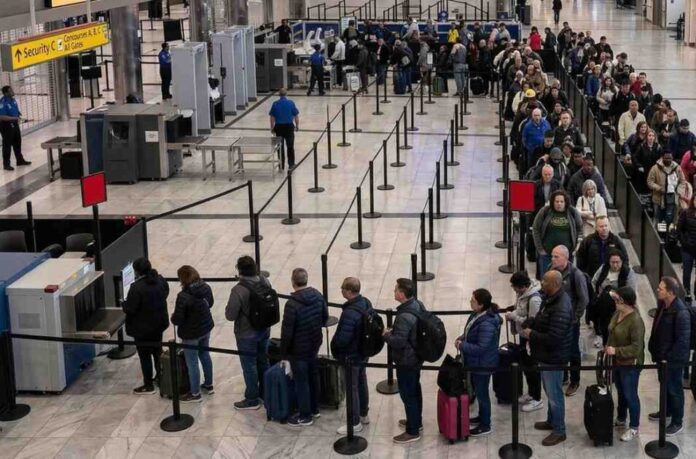
TSA’s acting chief warned Congress on Wednesday that absentee rates at major US airports have surged to 40–50%, with wait times hitting 4.5 hours — the longest in agency history — as the DHS funding shutdown enters its 40th day with no resolution in sight and airport closures becoming a real possibility.
WASHINGTON, D.C. — Acting TSA Administrator Ha Nguyen McNeill told the House Homeland Security Committee on Wednesday, March 25, that absentee rates among Transportation Security Officers have surged to 40–50% at several major hubs, up from a pre-shutdown baseline of just 4%, because officers “simply cannot afford to report to work,” according to her congressional testimony.
Security wait times have now crossed four and a half hours at the worst-affected airports — the longest delays in TSA history.
But the number that should alarm travelers most is not the wait time. It is the math underneath it. The TSA employs roughly 50,000 frontline screeners. If 40–50% are absent at key airports, those facilities are operating at roughly half the staffing they need to run safely — and McNeill explicitly warned Congress that smaller airports face temporary closure if the situation does not stabilise.
Resignations and the coming staffing cliff
460 TSA officers have resigned since the shutdown began on February 14, according to Reuters. That figure, on its own, looks manageable. What it obscures is the pipeline problem. American Federation of Government Employees Vice-President Cameron Cochems said an additional 2,100 agents have filed transfer papers to other federal agencies or local police departments. Those officers are still showing up — for now.
The DHS has dispatched ICE agents to 14 airports as emergency cover, a decision that has drawn sharp criticism from aviation security researchers who note these agents lack the specialised screening training that TSOs undergo. William McGee, a consumer advocate with the American Economic Liberties Project, put it plainly: “I’m uncertain we can continue” to claim the US operates the world’s safest aviation system.
The airports hardest hit are the ones travelers can least afford to avoid. At Houston Bush Intercontinental and Houston Hobby, absentee rates hit 50% and 40% respectively on recent days. New York JFK, Atlanta, and New Orleans recorded rates above 30%, according to DHS data reported by Reuters. Multiple security checkpoints at these airports have already been temporarily shut, funnelling thousands of passengers through fewer lanes.
What existing coverage has largely skipped past: assaults on TSA officers have risen more than 500% since the shutdown began in mid-February, according to testimony McNeill gave to lawmakers. Officers who are still showing up are doing so under financial distress and increasing physical danger. The agency has provided no updated data on assault incidents since that figure was disclosed.
Congress, airlines, and a stalled fix
Congress has not passed a funding resolution. A Senate vote to restore DHS funding failed in mid-March, and the House Homeland Security hearing this week carried no legislative vehicle. Major airline CEOs have called for an expedited resolution as spring break demand peaks, with 171 million passengers projected to fly through the end of April — a 4% increase over the same period last year.
The TSA has offered no public timeline for when it will release updated absenteeism data beyond McNeill’s congressional testimony. The agency has also not confirmed which specific airports are under active review for closure, or what threshold of officer absence triggers a shutdown decision, leaving airports, airlines, and passengers without a clear early-warning signal.
The shutdown effectively created two crises simultaneously: a travel disruption crisis that is visible to every passenger, and a workforce attrition crisis that will outlast any funding deal. Even if Congress resolves the impasse this week, the 460 officers who have already resigned are gone, and the 2,100 who have filed transfer papers represent institutional knowledge that will not be easily replaced. The real cost of a 40-day funding standoff may not show up in wait times. It will show up in staffing rosters for the next several years.
