
BRUSSELS / BAGHDAD — NATO completed the full withdrawal of all personnel from its Iraq advisory mission on Friday, March 20, 2026, relocating them to Joint Force Command Naples in Italy, after Iranian strikes hit British, French, and Italian bases in northern Iraq, according to an official NATO statement.
Iraqi officials put the number of departing personnel at approximately 1,200. NATO, for its part, described the figure only as “several hundred” — a discrepancy neither side has clarified publicly.
The withdrawal suspends NATO Mission Iraq, the alliance’s only active ground presence in the Middle East and the sole international programme training Iraqi security forces to prevent an ISIS resurgence. The mission has operated continuously since 2018. There is no confirmed timeline for its return.
That last detail is the one most mainstream coverage has moved past. NATO Secretary General Mark Rutte described the Iraq mission just months ago as the “cornerstone of NATO’s engagement in the Middle East.” That cornerstone is now sitting in Naples with no return date — at a moment when the security vacuum in Iraq is arguably deeper than at any point since ISIS held territory.
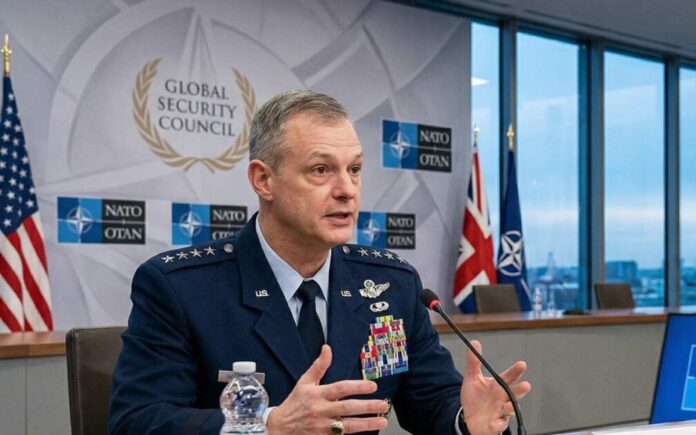
Gen. Alexus Grynkewich, NATO’s Supreme Allied Commander Europe, confirmed the departure and thanked Iraqi authorities for facilitating the evacuation. “They are true professionals,” Grynkewich said of the departing troops.
NATO officially describes the pullout as a temporary “adjustment of posture.” A security source cited by the Iraqi News Agency said the personnel are expected to return once the conflict stabilises, adding: the withdrawal was driven by “fears for their lives.” The alliance has not set any formal benchmark for what “stabilised” means.
The broader context matters here. Iraq sits at the intersection of the active US-Iran war, hosting both US troops and a constellation of Iran-linked armed factions that have launched drone and missile attacks on coalition bases throughout the conflict. NATO bases were not immune. Iranian-linked strikes directly targeted positions used by British, French, and Italian forces — all NATO member states — before the withdrawal decision was finalised.
US President Donald Trump has not let the pullout pass quietly. Trump publicly accused fellow NATO members of being “cowards” for refusing to commit forces to the blockaded Strait of Hormuz, and issued a blunt warning: “Without the USA, NATO is a paper tiger.” The withdrawal handed him a concrete data point.
The mission, which included troops from all 32 NATO member countries plus partner nations Austria and Australia, was established at Iraq’s explicit request to train its security institutions after the country declared territorial victory over ISIS in 2017. Its suspension now leaves Iraqi security forces without their primary foreign training support precisely when pro-Iranian militia activity inside Iraq is at its most intense in years.
Bloomberg reported, citing a person familiar with the decision, that the relocation was also influenced by “waning US interest” in maintaining the mission — adding a political dimension to what NATO is officially framing as a purely security-driven move.
What remains unresolved: whether NATO Mission Iraq will resume training operations remotely from Naples, how Iraqi forces will fill the capability gap, and whether Trump’s pressure will eventually push NATO members toward the Strait of Hormuz operation he has demanded. None of those questions have official answers yet.
