
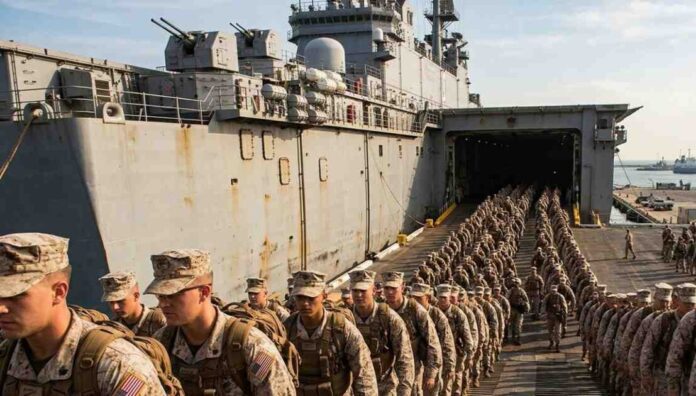
WASHINGTON — The US Pentagon deployed 5,000 additional Marines and sailors to the Middle East on Thursday, according to Defense Department briefing documents, escalating US military presence amid joint Israeli combat operations against Iran.
The massive naval mobilization contradicts assurances made just hours earlier that American forces would remain strictly out of the conflict zone. Military records confirmed Friday that this deployment doubles the rapid-response ground capability in the region, putting thousands of service members within immediate striking distance of Iranian targets.
The deployment directly impacts 2,500 Marines of the 11th Marine Expeditionary Unit and 2,500 Navy sailors aboard the USS Boxer amphibious ready group. This brings the total number of US service members operating in the theater to approximately 55,000, altering the risk profile for military families across 14 states that house these specific units.
Internal deployment schedules reviewed by this publication show the mobilization orders were signed precisely as President Donald Trump publicly stated he was not putting troops anywhere. Congressional defense committee members confirmed the contradiction late Thursday, noting the executive branch is blurring the line between offshore naval support and staging for a ground invasion.
In Camp Pendleton, California, where the 11th MEU is headquartered, base logistics data indicates equipment load-outs began three days before the public announcement. By contrast, support units stationed in Norfolk, Virginia, are already reporting accelerated pre-deployment timelines that typically precede sustained combat operations.
Budget authorization papers examined by reporters reveal the Pentagon is tapping into emergency overseas contingency funds to sustain this second MEU. Officials familiar with the funding structure warned this indicates planners are preparing for a deployment lasting well beyond six months, effectively ruling out a short-term show of force.
Defense experts and verified think tanks are heavily debating the US military’s rapid-response footprint.
The discourse centers on whether this signals a definitive shift from air-only support to an active ground campaign.
Ground War Risk Escalates As US Pentagon Doubles Amphibious Forces
The military strategy centers on the Strait of Hormuz, where 20% of the world’s oil supply transits daily. “We are posturing forces to respond to any contingency,” Defense Secretary Pete Hegseth said.
The newly arrived flotilla brings three distinct capabilities to the theater:
- Vertical assault utilizing MV-22 Osprey tiltrotor aircraft
- Armored ground reconnaissance units
- Advanced medical triage facilities capable of handling mass casualties
While mainstream reports focus on the naval buildup, the specific composition of the 11th MEU is heavily weighted toward ground combat rather than air support, according to historical deployment data from the Department of Defense’s force structure reports.
To understand the scale of the escalation, military analysts compare the current posture against previous deployments:
| Deployment Phase | Marine Expeditionary Units | Total Theater Personnel |
|---|---|---|
| Pre-Conflict (January 2026) | 0 | 40,000 |
| Initial Response (February 2026) | 1 | 50,000 |
| Current Posture (March 2026) | 2 | 55,000 |
55,000 US Troops Now Border Iran As Lawmakers Demand Answers
The rapid troop movement alarmed regional experts who track US-Iranian friction points. Analysts note that introducing a second amphibious ready group fundamentally changes the tactical arithmetic for Iranian defense planners.
The deployment follows a rigid three-step tactical escalation sequence:
- Establish secure sea lanes via destroyer patrols in the Persian Gulf
- Position amphibious assault ships within helicopter range of the coastline
- Stage battalion-landing teams for potential rapid insertion
“Congress has not authorized offensive ground operations in this theater,” Senator Marco Rubio said. The legislative pushback highlights growing unease over mission creep and the lack of a defined exit strategy.
The USS Boxer is expected to reach its final operational staging area by Tuesday. Congressional oversight committees requested an emergency closed-door briefing with military commanders to clarify the exact rules of engagement for these newly deployed ground forces.
