
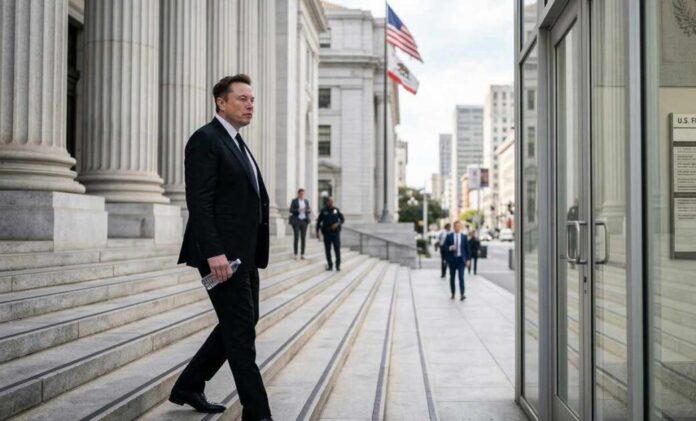
SAN FRANCISCO, CALIFORNIA — Closing arguments begin Tuesday, March 17, 2026, in Pampena v. Musk, the federal securities trial in which former Twitter shareholders claim billionaire Elon Musk deliberately misled the market to renegotiate or escape his $44 billion buyout of the platform, according to court filings reviewed by this publication. The case, brought before U.S. District Judge Charles R. Breyer at the Northern District of California, could result in damages approaching $1 billion — though the verdict may never stand.
The trial heads into its final stretch with a loaded asterisk: Musk’s legal team at Quinn Emanuel, led by attorney Alex Spiro, filed a mistrial motion on March 7, citing what they called irreversible contamination of the jury process. Of 93 prospective jurors screened during selection, 40 were dismissed after admitting they could not set aside their negative views of Musk. That figure — nearly 43% of the pool — now anchors the defense’s argument that no impartial jury could be seated in San Francisco. Judge Breyer acknowledged the animosity during Monday’s jury instruction conference but has not yet ruled on the motion.
Bot Percentage at Trial’s Core
The lawsuit covers shareholders who sold Twitter stock between May 13 and October 4, 2022 — the window spanning Musk’s bombshell tweet announcing the deal was “temporarily on hold” to the day he closed it. Those investors argue they sold at suppressed prices because Musk’s public statements — including claims that as much as 20% of Twitter accounts were fake — were designed to crash the stock for his own benefit.
Musk’s own testimony didn’t help him on tone. Court records reviewed by reporters from the trial show he described Twitter‘s official 5% bot estimate as “BS,” adding: “Anyone who used Twitter would realize there were a lot of bots and a lot of spam.” Former Twitter CFO Ned Segal directly contradicted that figure, testifying the real number was closer to 1% and that the company never filed false disclosures with the SEC.
Musk’s Mistrial Motion Raises Five Grounds
Documents reviewed by this publication show the mistrial filing raises five distinct grounds, not merely jury bias:
- Plaintiffs’ counsel allegedly violated a pretrial ruling barring references to Musk’s SEC disclosure failures related to his early, secret accumulation of more than 9% of Twitter stock
- Judge Breyer allegedly interfered with defense cross-examination of former Twitter CEO Parag Agrawal and CFO Ned Segal, while allowing plaintiff attorneys to use similar tactics unchallenged
- Plaintiffs repeatedly prompted attorney-client privilege objections during Musk’s testimony — a tactic the defense argues was designed to make Musk appear to be hiding evidence from the jury
- European privacy laws were cited by plaintiffs to explain why Twitter couldn’t share certain user data with Musk; the defense claims the court blocked them from rebutting that assertion
- The court restricted testimony from Musk’s own attorney, further limiting his ability to explain why he ultimately completed the acquisition
Judge Breyer has rejected each defense objection as it arose during trial. He has not issued a ruling on the consolidated mistrial motion.
The Overlooked Figure: $839 Billion vs. $1 Billion
What mainstream coverage consistently buries is the financial asymmetry at play. Data examined by reporters indicates Musk‘s current fortune stands at approximately $839 billion, making the potential $1 billion damages award — the high-end estimate cited by analysts — roughly 0.1% of his net worth. For the class of plaintiffs, that same figure represents the aggregate losses of thousands of ordinary investors who sold into a market Musk allegedly manipulated.
Investor Brian Belgrave told the court he sold thousands of Twitter shares in July 2022 after concluding Musk would abandon the deal. When Musk completed the acquisition at $54.20 per share, Belgrave said he had already exited at a lower price. “I got cheated,” he testified.
San Francisco as a Variable
The geographic concentration of the jury pool has become a trial variable in its own right. Court records show the jury was drawn entirely from the Northern District of California — a region where Musk relocated Tesla‘s headquarters away from in 2021, a move that generated significant local coverage and criticism at the time. Defense counsel argued during voir dire that the resulting hostility made seating an impartial jury in San Francisco structurally impossible. The judge disagreed, but let the record stand.
A separate SEC enforcement action against Musk over his delayed disclosure of his initial Twitter stake — which seeks more than $150 million in disgorgement and penalties — remains a distinct, ongoing proceeding and was explicitly barred from this trial.
What Comes Next
Closing arguments are expected to conclude before the court’s March 19, 2026 deadline. The jury will then deliberate, though Judge Breyer‘s pending decision on the mistrial motion could interrupt or void that process entirely. Neither side has publicly indicated willingness to settle. One attorney for the plaintiff class, Aaron Arnzen, has not responded to a request for comment on the motion’s current status.
