

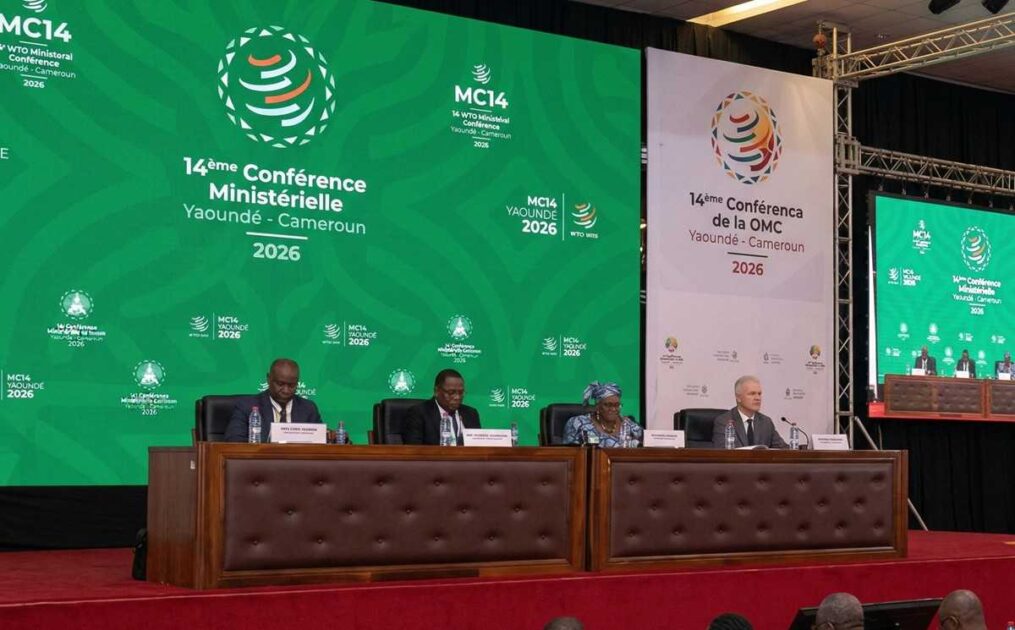

Trade ministers from 166 nations opened a four-day summit in Yaoundé on March 26 that WTO chief Ngozi Okonjo-Iweala has called a “turning point ministerial,” as deep divisions over institutional reform threaten to fracture the rules-based global trade system.
YAOUNDÉ, CAMEROON — The World Trade Organization’s 14th Ministerial Conference opened in Yaoundé on Thursday, March 26, with WTO Director-General Ngozi Okonjo-Iweala warning that the global trade order has “irrevocably changed,” as 166 member states gathered for four days of talks with no clear agreement in sight, according to delegates present at the opening session.
The core tension is immediate: the United States backs WTO reform in principle but is actively blocking a detailed work plan, while the European Union, United Kingdom, and China are pushing for a concrete framework with defined timelines, according to internal reform documents seen by Reuters. That gap is not procedural. It means the conference could end without a single enforceable commitment — and several senior diplomats are now saying that outcome would accelerate the WTO’s slide toward irrelevance.
EU Trade Commissioner Maroš Šefčovič did not soften the warning. “You have declining political support for the WTO and we want to reverse it,” he told the Financial Times ahead of the opening, adding that the goal was to “make sure that WTO becomes relevant again”. The directness of that statement from the EU’s most senior trade official signals how little confidence remains that business will proceed normally.
The dispute settlement impasse
At the center of the reform standoff is a crisis that predates this summit by six years. The WTO’s Appellate Body — the two-tier system that adjudicates trade disputes between nations — has been non-functional since late 2019, after the US began blocking appointments to its bench. As of January 27, 2026, the US had blocked a joint proposal from 130 countries to fill seven vacancies on the Appellate Body for the 94th consecutive time at the Dispute Settlement Body meeting, according to people familiar with the development.
US Trade Representative Jamieson Greer, speaking at the World Economic Forum in Davos in January, framed Washington’s position bluntly: the existing system was “built by unaccountable bureaucrats in Geneva” who “interpreted the rules so narrowly” that the US was repeatedly forced to change its own laws to accommodate rulings it had not agreed to at the bargaining table.
That argument has no support from the other 129 countries that co-sponsored the Appellate Body proposal. But it carries decisive weight — because the WTO’s consensus-based model means a single member can paralyse the entire mechanism indefinitely.
The practical consequence is stark. Use of the WTO’s dispute system has dropped from an average of 19 consultations per year between 2010 and 2019 to just 8.5 per year between 2020 and 2025, according to data from the UN Conference on Trade and Development. Disputes are not disappearing — they are simply going unresolved or moving outside the WTO framework entirely.
UK Trade Minister Chris Bryant, serving as one of the ministerial facilitators for reform discussions, put the institutional risk in direct terms: “My anxiety is if we ministers don’t get this week right, you might see a disorderly collapse of the WTO and some people writing a new rulebook,” he said ahead of the summit.
An interim alternative — the Multi-Party Interim Appeal Arbitration Arrangement (MPIA), created in April 2020 — exists as a workaround, but it has significant limitations. The US never joined it. Neither did India. Both argue the MPIA lacks the legitimacy of a properly functioning Appellate Body. With two of the world’s largest trading powers outside the mechanism, its reach remains structurally limited regardless of how many disputes it handles among its participating members.
What this conference now faces is a harder version of a familiar problem: reform requires consensus, but consensus requires the US to accept constraints it has spent eight years rejecting. Okonjo-Iweala acknowledged the decision-making model itself needs to change, suggesting the WTO should allow groups of members to form agreements without full consensus — a structural shift that would itself require consensus to implement.
The International Chamber of Commerce warned in a statement issued ahead of the summit that without meaningful reform, the business community faces “the worst industrial crisis in living memory,” driven by energy price volatility and food security risks tied to fertilizer supply disruptions, particularly across Africa.
Four days is an extremely short window to resolve disagreements that have compounded over nearly a decade. If the conference closes without a concrete reform pathway, the more likely outcome is not a dramatic collapse but a quieter one: more countries negotiating bilateral deals outside the WTO, fewer disputes filed through official channels, and a global institution that retains its name while losing its function.
