

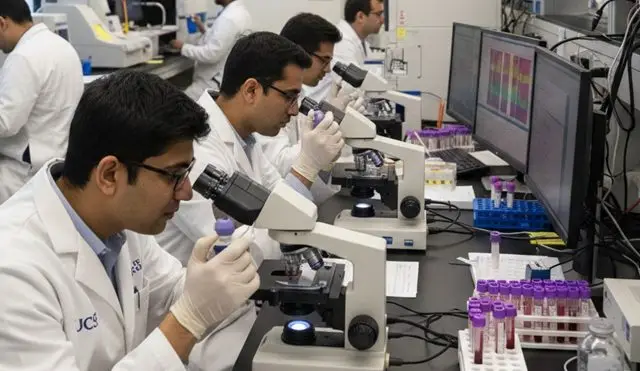

SAN FRANCISCO — University of California San Francisco researchers systematically mapped more than 260,000 orphan non-coding RNAs across 32 cancer types, creating digital molecular barcodes detectable in blood that distinguish cancer subtypes and predict treatment outcomes, according to findings published in Cell.
The discovery addresses a critical gap in post-chemotherapy monitoring for breast cancer survivors, who face challenges tracking minimal residual disease with existing cell-free DNA markers that often fail in early-stage detection.
Blood-Based Tracking Needs Just One Milliliter
Hani Goodarzi, associate professor at UCSF and core investigator at the Arc Institute, led research demonstrating that cancer cells actively secrete approximately 30% of these orphan RNAs into the bloodstream. Testing required only one milliliter of serum yet produced strong detection signals, researchers confirmed.
The team analyzed RNA sequencing data from The Cancer Genome Atlas spanning 32 major cancer types. Each cancer produces distinct patterns of these small non-coding molecules, absent in healthy tissues but consistently present in malignancies.
Machine learning algorithms trained on these patterns classified cancer types with over 90% accuracy in initial testing. Independent validation using samples from more than 900 tumors achieved 82% accuracy, according to peer-reviewed research.
Breast Cancer Subtypes Show Unique Signatures
Basal breast tumors displayed different orphan RNA patterns compared to luminal breast cancers, suggesting the molecules capture fundamental differences in cancer cell states. The digital molecular barcodes identify not just cancer type but also subtype variations and cellular states, researchers stated.
Validation studies focused on 192 breast cancer patients enrolled in the I-SPY 2 neoadjuvant chemotherapy trial. Blood samples collected before and after treatment measured oncRNA burden, tracking how molecular signatures changed through therapy.
Patients with high residual oncRNA levels after chemotherapy showed nearly four times lower overall survival compared to those with reduced burdens. The predictive power remained significant even when controlling for standard clinical measures, researchers noted.
Five Percent Drive Tumor Growth
Large-scale genetic screening in xenograft mice tested 400 orphan RNAs for functional roles in cancer progression. Approximately 5% directly boosted tumor growth when activated, the team discovered.
Detailed analysis of two specific oncRNAs revealed distinct mechanisms. One promoted epithelial-mesenchymal transition, a cellular process critical during metastasis. The other activated E2F genetic pathways that drive cancer cell proliferation. Both linked to increased tumor growth and metastatic spread in human cell lines and patient tumor data, according to systematic analysis.
Addressing DNA Shedding Limitations
Current minimal residual disease monitoring relies heavily on cell-free DNA detection, which faces obstacles in breast cancer surveillance. Tumors shed limited DNA quantities, particularly in early stages when intervention could prove most effective.
Cancer cells actively secrete RNA rather than passively releasing DNA fragments, researchers explained. This active secretion mechanism offers advantages for real-time monitoring applications where DNA-based approaches struggle.
The open-source resource created by the research team maps orphan RNA patterns across all major cancer types, available through published data repositories. Goodarzi stated the comprehensive atlas could open new research directions for identifying cancer-emergent molecules functioning as both drivers and biomarkers.
Future investigations will identify orphan RNA signatures specific to additional cancer subtypes and examine links to treatment responses in larger patient populations. Exai Bio, a biotechnology company co-founded by Goodarzi, is developing oncRNA-based diagnostics leveraging artificial intelligence to improve cancer detection and patient stratification.
