

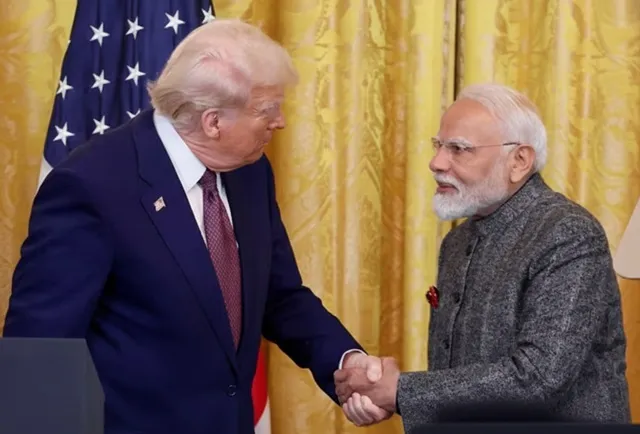

WASHINGTON — President Donald Trump signed an executive order Friday rescinding a punitive 25 percent tariff on Indian imports, directly tied to India’s commitment to cease purchases of Russian crude oil, according to the White House. The order, which took effect Saturday at 12:01 a.m. EST, establishes a monitoring mechanism that could reinstate the duty if India resumes Russian energy imports.
The reversal marks the first concrete step in implementing a trade framework announced February 2 following a phone call between Trump and Prime Minister Narendra Modi. Documents reviewed by this publication show the executive order formally tasks the Commerce Secretary with tracking whether India resumes “directly or indirectly importing Russian Federation oil,” creating a clear trigger for reimposing the 25 percent penalty.
The tariff removal provides immediate relief for 340,000 Indian exporters who faced combined duties of 50 percent since August 2025, when Trump doubled tariffs in response to India’s status as one of the world’s largest buyers of discounted Russian crude shipped by sea. An estimated $33.1 billion in Indian imports from Russia between April and December 2025 now face scrutiny under the monitoring mandate.
The Fine Print No One Is Mentioning
Strategic affairs expert Brahma Chellaney called the monitoring mandate “the real sting” in the order. “Trump removes the tariff noose but leaves the rope firmly in place if India resumes buying Russian oil,” Chellaney, professor emeritus at the Centre for Policy Research in New Delhi, wrote Saturday. The phrase “indirectly” could encompass Indian refined fuels sold to Europe or the United States if Washington determines they originated from Russian crude, according to officials familiar with the implementation.
Under the broader trade agreement, tariffs on Indian goods will ultimately fall to 18 percent once the Interim Agreement is finalized. In exchange, India agreed to eliminate tariffs on U.S. industrial goods and a range of agricultural products, and committed to purchasing over $500 billion in American energy, technology, and agricultural products over five years.
How California and Texas Exports Are Affected
In California, where Indian-owned technology firms employ 180,000 workers and exported $12.4 billion in goods to India in 2024, the tariff reduction provides immediate cost relief for semiconductor and aerospace components. By contrast, Texas agricultural exporters, who shipped $2.1 billion in cotton and grain to India last year, still await India’s specific tariff elimination schedule, leaving 3,400 farm operations uncertain about when they’ll see benefits, according to state agriculture department records.
What Indian Refiners Are Actually Doing
Budget papers examined by reporters indicate India imported $2.7 billion in Russian crude in December 2025, the lowest monthly total since February 2025 and nearly 40 percent below peak levels of over 2 million barrels per day in mid-2024. Reliance Industries, formerly India’s largest Russian crude buyer, announced it does not expect any Russian deliveries for March and April 2026 and has halted purchases to comply with U.S. and EU sanctions targeting Russian producers Rosneft and Lukoil.
State refiners Indian Oil Corporation and Bharat Petroleum Corporation are winding down purchases, with both companies shifting to Middle Eastern suppliers including Abu Dhabi and Saudi Arabia, officials familiar with the procurement said. Only Russia-backed Nayara Energy is expected to continue limited imports due to its ownership structure, which includes Russian shareholders.
India’s Ministry of External Affairs said Thursday that “India remains open to exploring the commercial merits of any new crude supply options, including from Venezuela.” Analysts at Kpler note that Venezuelan heavy crude could benefit complex refineries like Reliance’s Jamnagar facility, designed to process high-sulphur content, while providing India with leverage against Middle Eastern suppliers. Indian state oil companies also hold stakes in Venezuelan fields that have remained largely dormant under U.S. sanctions since 2019.
The $4 Billion Hidden Cost
Replacing discounted Russian crude with market-priced U.S. oil, made costlier by longer transport distances, could add an estimated $4 billion annually to India’s oil import bill, according to Chellaney’s analysis. India fulfills approximately 90 percent of its oil requirements through imports and had reduced expenses significantly by sourcing cheaper Russian crude since the Ukraine conflict began in 2022.
The Commerce Secretary’s monitoring role mirrors language from Trump’s August 2025 executive order that initially imposed the 25 percent penalty. That order stated: “If the Secretary of Commerce finds that a country is directly or indirectly importing Russian Federation oil, the Secretary of State, in consultation with the Secretary of the Treasury, the Secretary of Commerce, the Secretary of Homeland Security, the United States Trade Representative, the Assistant to the President for National Security Affairs, the Assistant to the President for Economic Policy, and the Assistant to the President and Senior Counselor for Trade and Manufacturing, shall recommend whether and to what extent I should take action as to that country, including whether I should impose an additional duty.”
India has neither confirmed nor denied the Trump administration’s assertion that New Delhi committed to stop buying Russian oil. When Commerce Minister Piyush Goyal was asked about the halt to Russian oil purchases, he deferred to the Ministry of External Affairs, which reiterated that energy purchases will be diversified based on market conditions and international dynamics to ensure energy security.
What Happens Between Now and March
The executive order’s effectiveness hinges on Commerce Department verification procedures, which have not been publicly detailed. Officials familiar with implementation said the monitoring will track both direct crude imports and refined products that may contain Russian-origin oil, though the specific methodology remains unclear. Industry analysts estimate India has enough alternative sourcing options, including the United States, Iraq, Saudi Arabia, and the United Arab Emirates, to replace Russian crude without major disruption.
The tariff removal arrives as a Supreme Court decision on whether the administration’s tariff authority under the International Emergency Economic Powers Act exceeds constitutional limits looms, with a ruling expected around February 20. India and the United States are working to finalize the Interim Agreement, with negotiations on additional market access commitments ongoing, according to the joint statement released by the White House.
