

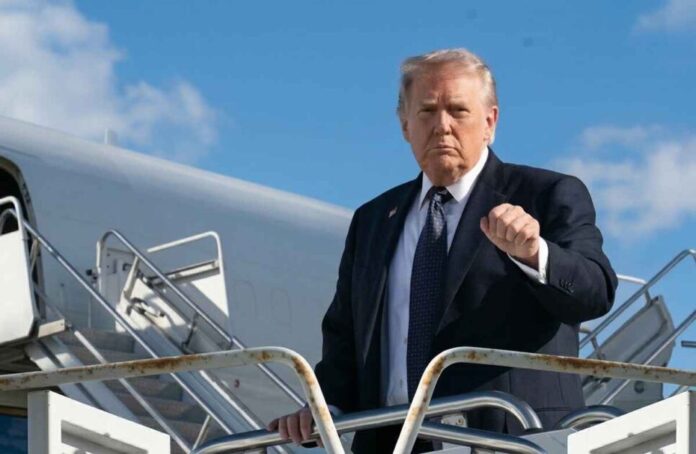
WASHINGTON — President Donald Trump faces a severe political crisis Monday in Washington, according to new polling data, with his escalating military campaign in Iran driving domestic gas prices to crippling highs.
The conflict quietly drained $12 billion in just over two weeks, contradicting early administration promises of a limited engagement. Economic data reviewed by reporters shows the ensuing disruption in the Strait of Hormuz pushed national average gas prices past $3.50 per gallon, delivering an immediate 21% price spike.
The economic blowback hits working-class commuters and logistics companies directly, as they absorb a historic 35% surge in crude oil costs that threatens to derail the broader domestic supply chain.
Documents from major financial institutions examined by this publication reveal the conflict is rapidly destabilizing the US economy from the inside out. Goldman Sachs elevated its 12-month domestic recession probability to 25%, while BCA Research placed the risk at 40%. The strain compounds an already fragile foundation, following a downward revision of fourth-quarter GDP to just 0.7%.
The political fallout manifests sharply in key battleground states like Pennsylvania, where working-class voters are highly sensitive to energy costs. Regional economic indicators show deep frustration over the $3.50 pump prices, compounding anxieties from the 92,000 domestic jobs lost in February, according to the Bureau of Labor Statistics employment data.
What nobody at the Pentagon is saying publicly is that internal metrics reveal a collapse in trust from the president’s own political base. A CNN poll indicates only 37% of Republicans strongly approve of the strikes, while 46% express limited trust in the administration’s military decision-making regarding Tehran.
Wall Street Warns US Economy Faces Iran War Recession
White House National Economic Council Director Kevin Hassett disclosed the $12 billion price tag Sunday on CBS, confirming the steep fiscal toll of Operation Epic Fury. The operation, launched February 28 alongside Israel, continues to mount heavy physical and financial costs.
The human and financial toll currently stands at:
- $12 billion in operational expenditures
- 13 US service members killed and 140 wounded
- 1,444 Iranian casualties
“Iran has been militarily defeated,” Trump claimed during an NBC interview.
The president casually floated the possibility of targeting Kharg Island, the vital Iranian oil terminal, simply for amusement. However, statements from Tehran directly contradict the administration’s optimistic diplomatic timeline. Iran’s foreign minister flatly rejected the assertion that the country was ready to negotiate, stating definitively that they have not sought a ceasefire.
Rising Gas Prices Destroy Trump Approval Among Core Republicans
Public surveys demonstrate a steep decline in commander-in-chief confidence across three major trackers:
| Polling Firm | Overall Approval | Key Finding |
|---|---|---|
| Marist | 36% | 54% disapprove of war handling |
| Reuters/Ipsos | 39% | 56% say too willing to use force |
| Daily Mail | 44% | Lowest in outlet’s tracking history |
Dissent now openly fractures the conservative coalition. Former Representative Marjorie Taylor Greene accused the administration of betraying its fundamental promises, while commentator Tucker Carlson publicly condemned the operation as evil during an ABC News interview.
Congressional efforts to reclaim war powers failed through a strict legislative sequence:
- Senators Tim Kaine and Rand Paul introduced a binding resolution to halt operations
- The Senate rejected the measure 47-53, with John Fetterman as the lone Democratic holdout
- Speaker Mike Johnson subsequently blocked parallel measures in the House
Defense Secretary Pete Hegseth confirmed the intensity of military strikes will actually increase. The administration now faces a protracted overseas conflict with no diplomatic off-ramp, as gas prices continue their upward trajectory toward the summer driving season.

