

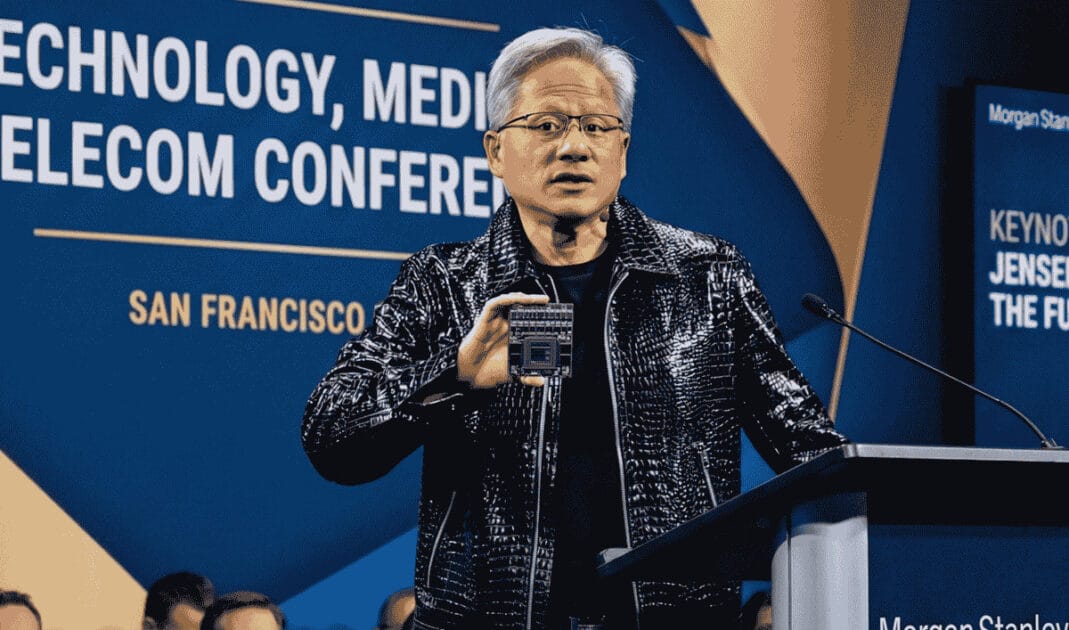

SAN FRANCISCO, CALIFORNIA — Nvidia CEO Jensen Huang said on Wednesday, March 4, at the Morgan Stanley Technology, Media and Telecom conference in San Francisco that his company’s $30 billion investment in OpenAI and $10 billion stake in Anthropic will likely be its last in either company, according to statements he made from the conference stage and subsequently reported by TechCrunch and Reuters.
The announcement lands in the middle of a full-blown crisis. OpenAI signed a deal with the U.S. Pentagon on February 27 to deploy its AI on classified military networks — a contract struck just hours after the Trump administration banned federal agencies from using Anthropic’s technology. Since then, nearly 800 OpenAI and Google employees have signed an open letter opposing the deal, protests have broken out outside OpenAI’s offices in San Francisco and London, and the QuitGPT campaign claims to have mobilized over 1.5 million people into boycott actions.
The $70B That Won’t Happen
Huang had originally pledged up to $100 billion into OpenAI. What actually got wired: $30 billion. The gap between those two numbers has a history. Nvidia disclosed in a November 2025 quarterly filing that the full $100 billion plan “might not happen,” and by January 2026, the Wall Street Journal reported the arrangement was informally “on ice”.
At the Morgan Stanley stage, Huang offered the IPO window as his explanation — once OpenAI and Anthropic go public, the opportunity to buy private stakes closes. Straightforward enough. Except, as documents reviewed by reporters at TechCrunch note, late-stage private investing routinely continues right up to the eve of a public debut, which makes that explanation harder to accept at face value.
Huang explicitly dismissed suggestions that tensions between the two companies played a role — calling such speculation “nonsense”. But Nvidia is now sitting on stakes in two companies pulling in opposite geopolitical directions: OpenAI, which accepted Pentagon access, and Anthropic, which was subsequently labeled a “supply chain risk” by the Defense Department for refusing.
The Deal Nobody Cleared
The contract that started the firestorm was signed on February 27 — the same day the Trump administration ordered agencies to stop using Anthropic’s technology, and just one day before the U.S. struck Iran, according to reporting by CNN and Business Insider.
OpenAI CEO Sam Altman publicly posted an internal memo to X on March 3, acknowledging the company “got things wrong” and that it should not have “rushed” to close the agreement.
“We are going to amend our deal,” Altman wrote — adding language that explicitly bars OpenAI services from being used by Pentagon intelligence agencies, including the NSA.
Three days earlier, Anthropic had explained publicly why it walked away. The Pentagon had demanded unrestricted access to its Claude AI system, including the ability to use it for mass domestic surveillance and fully autonomous weapons without human oversight. Anthropic refused both — a position that, according to the company, cost it its government contracts.
What 796 Employees Put in Writing
The internal and external backlash moved faster than Altman’s amendment.
An open letter titled “We Will Not Be Divided” — addressed to both OpenAI and Google leadership — collected 796 signatures from employees at both companies by March 3, according to The Guardian. The letter warned that the U.S. government was attempting to “divide each company with fear that the other will concede,” and urged leaders to collectively refuse demands for surveillance and autonomous killing capabilities.
OpenAI research scientist Aiden McLaughlin went further on X, writing that he personally did not believe the deal “was worth it.” The number of public dissents from inside OpenAI is notable given the company’s historically tight internal culture.
“No Killer Robots, No AI Surveillance”
QuitGPT, a grassroots campaign that organized the street demonstrations under the banner “No Killer Robots, No AI Surveillance,” says its mobilization has passed 1.5 million people taking some form of action — canceling ChatGPT subscriptions, sharing boycott pledges, or signing its public petition.
Physical protests hit OpenAI’s offices in San Francisco on Tuesday, March 3, with a second confirmed demonstration organized in London. A national protest march — from Anthropic’s headquarters to OpenAI and xAI offices — is scheduled for March 21.
One unanswered question this publication could not confirm by deadline: whether the QuitGPT figures represent net cancellations or total engagement actions — a distinction that would significantly change what those numbers mean for OpenAI’s subscriber base.
What Nvidia Doesn’t Say Out Loud
The circular logic of Nvidia’s investment position deserves attention. Money Nvidia puts into Anthropic is likely to be spent on Nvidia’s own AI chips — a dynamic that MIT Sloan economist Michael Cusumano flagged publicly as a potential conflict of interest. Anthropic co-founder Dario Amodei has previously compared unrestricted U.S. chip sales to adversaries to “selling nuclear weapons to North Korea” — a characterization that implicitly pointed at Nvidia’s export policies.
Huang did not address that specific tension in his Morgan Stanley remarks. Nvidia did not respond to requests for additional comment on the strategic timing.
OpenAI’s contract amendment is still being finalized — no revised text has been published as of March 5, 2026. Anthropic’s status as a Pentagon “supply chain risk” remains active. And Nvidia, having extracted itself from the middle of both, now watches from the position it has always been most comfortable in: selling the shovels to everyone in the gold rush, regardless of where they’re digging.
