


PASADENA, California — Scientists detected ammonia-bearing compounds on the surface of Jupiter’s moon Europa for the first time through re-analysis of decades-old Galileo spacecraft data, NASA announced Thursday, marking the first identification of a nitrogen-bearing species on the icy moon with significant implications for its potential to harbor life.
Researcher Al Emran of NASA’s Jet Propulsion Laboratory in Southern California identified faint ammonia signals near fractures on Europa’s frozen surface by examining data from the mission’s Near-Infrared Mapping Spectrometer captured during Galileo’s 11th orbit of Jupiter in 1997, according to NASA’s official announcement. The Galileo spacecraft studied the Jupiter system between 1995 and 2003.
Why Nitrogen Matters
Ammonia is a nitrogen-bearing molecule, and nitrogen—alongside carbon, hydrogen, and oxygen—ranks among the essential elements for life as scientists understand it. Nitrogen serves as a key building block of DNA and RNA, the most important biological molecules crucial for all living things, according to biological research on nitrogen’s role in life.
The compounds appear to have reached the surface through geologically recent cryovolcanism, with liquid water containing dissolved ammonia rising through cracks in the moon’s icy shell. Ammonia significantly lowers water’s freezing point, functioning as natural antifreeze, and has a short lifespan when exposed to the harsh space environment, the NASA statement noted.
These characteristics, combined with detections near large fractures and pits, suggest active transport of material from either Europa’s subsurface ocean or shallow subsurface. The findings appear in a research paper published in The Planetary Science Journal, which proposes that the presence of ammoniated compounds implies “a thinner ice shell and a thicker, chemically reduced, high-pH subsurface ocean on Europa,” according to the study.
Competing Views on Habitability
The ammonia discovery arrives amid ongoing scientific debate about Europa’s potential to support life. Earlier this month, a study led by planetary scientist Paul Byrne of Washington University in St. Louis published in Nature Communications suggested Europa’s seafloor may be tectonically quiet and lack the hydrothermal activity that supported life’s emergence on Earth.
Byrne and colleagues conducted extensive modeling to assess potential tectonic activity in Europa’s theorized subsurface ocean. They found that stresses from tides, global contraction, mantle convection, and serpentinization are likely insufficient to drive tectonic activity, even along pre-existing fractures on Europa’s seafloor at this time.
“Europa likely has some tidal heating, which is why it’s not completely frozen. And it may have had a lot more heating in the distant past,” Byrne said in a statement. “But we don’t see any volcanoes shooting out of the ice today like we see on Io, and our calculations suggest that the tides aren’t strong enough to drive any sort of significant geologic activity at the seafloor.”
However, separate research published January 20 in scientific journals proposed that radiation-created chemical nutrients in Europa’s ice crust could sink into the ocean through a process called crustal delamination, potentially sustaining life even without seafloor volcanism. Jupiter’s intense radiation constantly bombards Europa’s surface, interacting with salts and other materials to form oxidants and nutrients useful for oceanic microbes.
Legacy Data Yields New Discoveries
NASA emphasized the findings underscore “the ongoing value of legacy datasets collected by previous space missions, which researchers can mine for new discoveries using modern analysis techniques,” according to the agency’s statement.
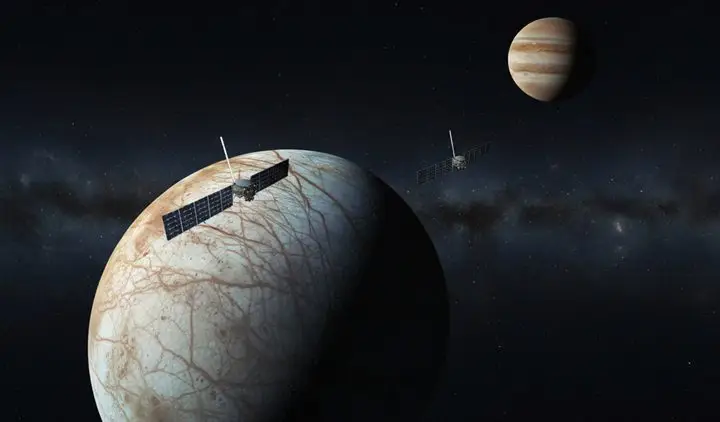
The ammonia detection provides a specific target for NASA’s Europa Clipper mission, which launched October 14, 2024, and will arrive at the Jupiter system in April 2030 to conduct 49 close flybys of Europa. The spacecraft will use gravity-assist maneuvers involving Mars in March 2025 and Earth in December 2026 during its 5.5-year journey to the Jovian system.
Europa Clipper carries nine science instruments designed to measure the moon’s ice shell thickness, subsurface ocean characteristics, surface composition, and potential plumes of water vapor. The mission aims to determine whether conditions suitable for life exist beneath Europa’s frozen crust, building on decades of observations suggesting a vast liquid water ocean lies beneath the ice.
The discovery demonstrates how advanced analytical techniques applied to archived spacecraft data can reveal information missed in initial examinations, opening new avenues for understanding Europa’s geology and astrobiological potential.
