

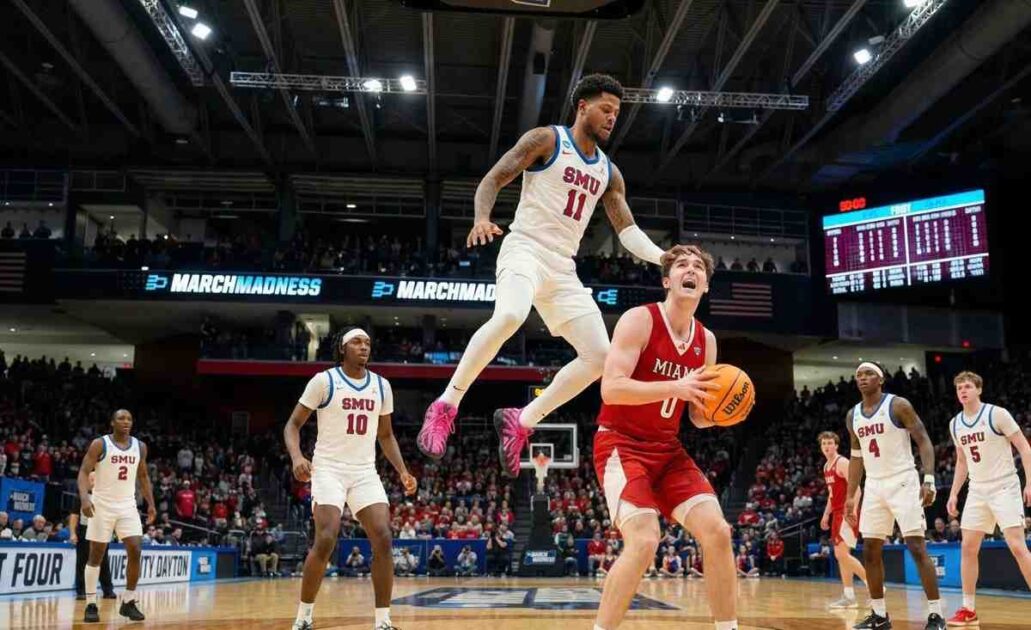

This wasn’t just a win. It was a formal response to months of skepticism.
Miami (Ohio) entered the tournament carrying a 31-1 record—the best in school history—yet spent most of Selection Sunday under a cloud of doubt because of a strength-of-schedule ranking that sat at 344th out of 365 Division I programs, according to the NCAA Evaluation Tool. Wednesday night, playing against an ACC opponent in front of a national television audience, the RedHawks answered those questions loudly—19 made three-pointers, a First Four record for made threes by a MAC team in tournament history.
Elmer dominated with 23 points in just 24 minutes of playing time, going 6-of-9 from three-point range. Bryant Byers added 19 points and Luke Skaljac chipped in 17 as three RedHawks finished in double figures. The RedHawks didn’t just win—they attempted 41 three-pointers in 64 total shots, a shooting profile that sets a First Four record for attempts from beyond the arc.
RedHawks’ Record Hides a Deeper Story
The fresh angle that mainstream coverage glosses over: Miami (Ohio) didn’t earn an automatic bid. The committee gave them an at-large berth as the final team in the field, making them the first Mid-American Conference squad to receive an at-large invitation since the Wally Szczerbiak-led 1999 team that advanced to the Sweet 16. Records reviewed by reporters confirm the RedHawks went 31-0 during the regular season—only to lose in the MAC Tournament quarterfinals to UMass 87-83, forcing the committee to decide whether their near-perfect record outweighed a schedule ranked near the very bottom of Division I. It did. Barely.
SMU was not without weapons. Center Jalen Toombs finished with 20 points and guard Jahmar Pierre Jr. scored 18, but the Mustangs never found consistent stops on a Miami (Ohio) offense that operated like a three-point machine. SMU also entered the game without senior guard BJ Edwards, sidelined before tip-off, a personnel loss that complicated their defensive rotations against Elmer’s relentless movement off screens.
Miami’s Three-Point Formula Faces Real Test
The deeper question—one that analysts on the CBS Sports postgame segment raised directly—is whether this shooting-dependent offense can replicate Wednesday’s efficiency against No. 6 seed Tennessee, a program that has reached the Sweet 16 in three consecutive seasons under coach Rick Barnes. The Volunteers feature elite athleticism and length on the perimeter, precisely the kind of defense that disrupts timing shooters like Elmer.
Data examined by reporters indicates Miami (Ohio)‘s shooting volume—41 attempts from three in one game—is sustainable only when the offense generates high-quality open looks. Against Tennessee’s switching defense, those looks will require sharper ball movement and off-ball screening. Whether Peter Suder—who led the RedHawks in assists Wednesday—can organize that kind of attack against a top-25 defense is the question nobody in Oxford, Ohio has fully answered.
First Win Since 1999 for the Program
The last time Miami (Ohio) won an NCAA Tournament game was 1999, when the Wally Szczerbiak-era squad advanced to the Sweet 16. The program made a brief return to the tournament in 2007, falling to No. 3 Oregon 58-56 in the Round of 64—a one-possession loss that still stings locally. Wednesday’s victory ends a 27-year drought in tournament wins and represents the 18th overall NCAA Tournament appearance in program history.
“It’s been a dream ever since I was a kid to play in the NCAA Tournament,” senior guard Suder said after the selection announcement last week. Wednesday night, his team did more than just appear. One person who could not be reached for comment: any serious analyst still arguing Miami (Ohio) didn’t belong in the field.
Next: Tennessee Awaits in Philadelphia
Miami (Ohio) advances to face No. 6 Tennessee on Friday in Philadelphia as part of the Midwest Region bracket. The Volunteers are a program built on physical defense and high-tempo offense—a style that will pressure Miami‘s perimeter game in ways SMU could not. Whether Elmer’s shooting efficiency holds against that level of competition remains the tournament’s most intriguing open question heading into the weekend. No timetable exists yet on BJ Edwards’ status for SMU, whose season ends without further appeal.
