

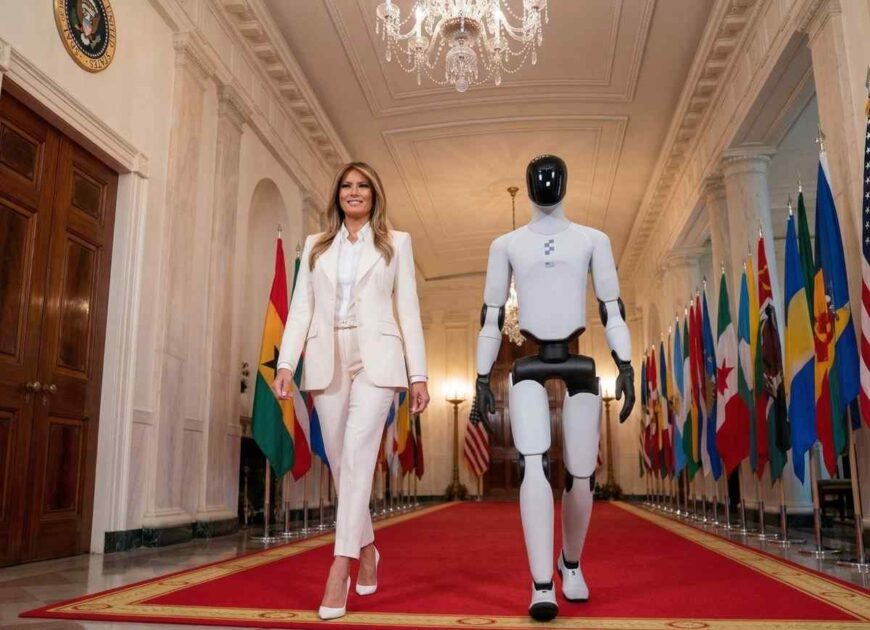

First Lady Melania Trump introduced the Figure 03 humanoid robot at a White House summit on Wednesday, pitching the $25,000 physical labor machine as a future autonomous classroom educator, signaling a controversial potential shift in American education policy.
WASHINGTON, D.C. — First Lady Melania Trump formally endorsed autonomous robotics for child development Wednesday at the White House, according to official summit transcripts, immediately accelerating federal debates over AI deployment in public school classrooms.
While viral clips focused on the faceless Figure 03 robot escorting the First Lady down the East Room red carpet, the actual policy directive delivered during the “Fostering the Future Together” summit went largely ignored. Trump explicitly proposed transitioning these machines into “hypothetical humanoid teachers,” pitching a future where physical artificial intelligence provides personalized, adaptive education to American children.
The proposition reveals a stark disconnect between political ambition and current technological reality. Built by California-based startup Figure AI, the Figure 03 model is primarily engineered for manual labor—folding laundry, moving boxes, and performing warehouse tasks. The robot currently lacks specialized pedagogical software, making its sudden rebrand as an educational tool a massive conceptual leap.
This policy pivot directly concerns the 3.2 million public school teachers across the United States, alongside a global EdTech industry projected to reach $400 billion by 2028. If federal grant structures adapt to subsidize robotic hardware over human personnel, educational funding could radically shift toward Silicon Valley hardware developers.
The administration’s focus on humanoid educators introduces three immediate challenges:
- Hardware costs average $25,000 per unit
- Unresolved legal liability regarding autonomous machines interacting with minors
- Complete lack of peer-reviewed data proving physical robots outperform traditional digital software in childhood development
Figure AI CEO Brett Adcock attended the presentation but stopped short of confirming a dedicated school rollout or a timeline for educational software integration.
“Our current deployment focuses on enterprise logistics and domestic assistance,” Adcock stated.
Capabilities of the Figure 03 model
The difference between the administration’s pitch and the hardware’s actual design creates a significant information gap for school districts watching the developments. The robot utilizes advanced spatial awareness and grip strength to navigate physical environments, not natural language processing optimized for childhood psychology or curriculum delivery.
| Metric | Figure 03 Current Reality | White House Pitch |
|---|---|---|
| Primary Function | Warehouse logistics, domestic chores | Classroom instruction, child development |
| Interaction Style | Task-based physical execution | Adaptive, personalized pedagogy |
| Unit Cost | Roughly $25,000 | Unsubsidized for public school budgets |
Impact on global EdTech markets
The endorsement at the highest level of the US government sends immediate signals to global tech markets. In technology hubs from Silicon Valley to Bengaluru, India, robotics developers are now monitoring whether the Department of Education will open procurement pipelines for physical AI systems. Indian EdTech firms, which previously focused heavily on screen-based software and mobile tutoring, face impending pressure to partner with hardware manufacturers to remain competitive in upcoming global government contracts.
The White House demonstration ultimately serves as a high-profile marketing pivot rather than an imminent classroom reality. By framing a warehouse logistics robot as a future teacher, the administration is testing public appetite for replacing human infrastructure with silicon alternatives. The true immediate risk is not that robots will suddenly replace teachers, but that federal education budgets may soon be diverted to fund corporate robotics testing under the guise of classroom innovation.
