

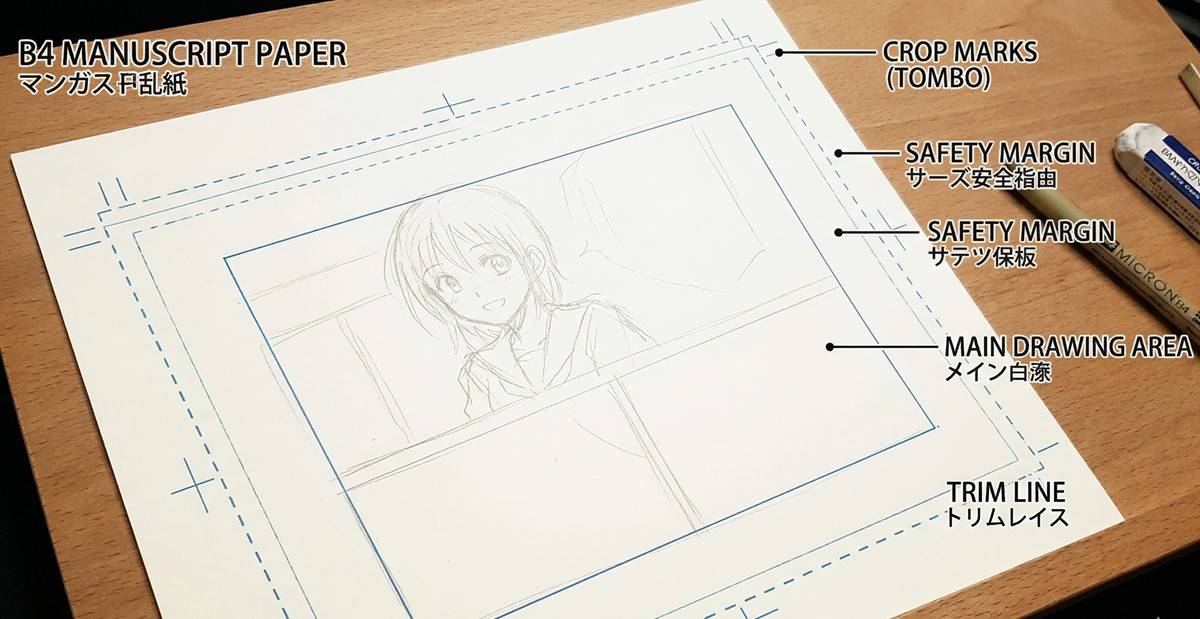

The professional manga industry operates on a paper standard that most online drawing tutorials fail to explain accurately: artists draw on B4-sized manuscript paper (257×364mm), not on the smaller book size readers eventually hold in their hands, according to specifications established under JIS (Japanese Industrial Standards) and confirmed by major manga supply manufacturers including Deleter, the industry’s leading manuscript paper brand.
The gap between the drawing canvas and the final printed product is where most aspiring artists — especially digital creators — make critical mistakes.
B4 is the drawing standard. B5 is the magazine page. B6 is the tankobon. These are three completely different sizes, and conflating them is the single most common error in manga tutorials circulating across English-language art communities. According to Clip Studio TIPS, the correct rule is a consistent one-size-up principle: draw on paper one size larger than the final printed output. A B5-finished magazine page requires drawing on A4 (210×297mm). A B6-finished tankobon — the standard paperback volume sold in Japanese bookstores — requires drawing on A5, or can be reduced from earlier A4/B5 artwork.
The reason this matters goes beyond preference. Manga is drawn at a larger size so that inking, screentone patterns, and fine linework retain clarity after the publisher reduces the page during printing. According to the Scribd-published Manga Paper Guide, Japanese magazines scale submitted pages down to 83% of original size for their B5 magazine format, and further to 67% for the B6 comic book format. Any linework that looks acceptable at full drawing size becomes sharper and crisper at reduced scale — but artwork created at the final print size has no reduction buffer, leaving lines that can look thin, inconsistent, or pixelated in press output.
The resolution requirement compounds this. For print, the Japanese publishing standard mandates 600 DPI minimum for monochrome manga pages, and some major publishers request up to 1200 DPI for digital submissions, according to Clip Studio’s official documentation. At 600 DPI on a B4 canvas (257×364mm), the pixel dimensions are approximately 6,071×8,598 pixels — a file size that many beginners set far too small when they simply pick “A4 at 300 DPI” and begin drawing, based on generic advice from software default settings.
Margin structure on manuscript paper
The standard manuscript page is not simply a blank B4 sheet. It carries a precise internal structure that defines what gets printed, what gets trimmed, and what can never be used for critical story elements. According to the Manga Paper Guide, the standard B4 manuscript paper (310×220mm as physically sold by Deleter, which includes a small production border) contains a main content area of 270×180mm, surrounded by a 20mm outer margin reserved for miscellaneous text, chapter numbers, and publisher notes.
A 3mm inner bleed margin is the minimum safe zone near the spine — the bound edge of the book — where visibility is restricted once pages are glued together. Illustrations that bleed to the page edge may extend to the full paper boundary except for this inner margin. Critical story content — speech bubbles, character faces, plot text — must stay within the inner safety zone to survive both trimming and binding.
For digital artists working in Clip Studio Paint, the software’s built-in manga preset for commercial use sets the final trimmed page at 220×310mm with crop marks and bleed area included in the canvas, as confirmed in a November 2024 tutorial on the platform’s official guide channel. Artists who skip the preset and manually enter dimensions frequently omit the bleed zone entirely, which results in white borders appearing on the final printed page.
US-based artists face an additional layer of confusion. The standard manga trim size sold in American bookstores — sometimes called “Tokyopop size” or “digest format” — measures approximately 5 inches × 7.5 inches (roughly 127×190mm), smaller than the Japanese B6 tankobon. Drawing for the American market at that final size without working at a larger canvas is a common workflow error identified across multiple art communities. The accepted solution remains the same: work at a larger drawing canvas and scale down for the target market, not the reverse.
The core tension for the growing global manga creator community is not about which software to use or which style to adopt — it is about understanding that the paper standard was engineered as a production system, not an artistic preference. B4 is not the size readers see. It is the size the industry needs to make what readers see look right.
