

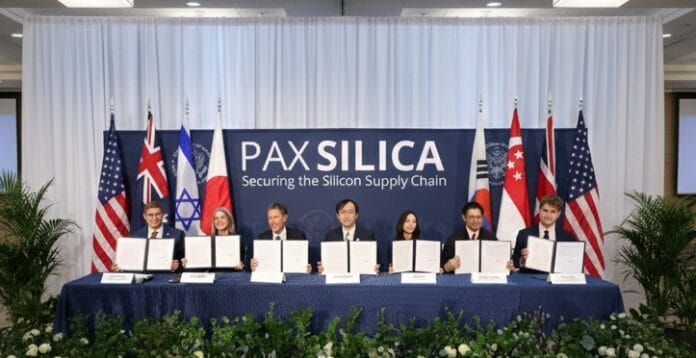
WASHINGTON — US Under Secretary of State for Economic Affairs Jacob Helberg officially confirmed Thursday that India will join the Pax Silica initiative in February 2026, according to remarks delivered at the Hudson Institute, marking the world’s largest democracy’s induction into a coalition designed to secure global AI and semiconductor supply chains. The announcement reverses India’s exclusion from the alliance’s inaugural summit held December 12, 2025, when seven founding nations signed the declaration without New Delhi at the table.
From Exclusion to Strategic Partner
Pax Silica launched with the United States, Japan, South Korea, United Kingdom, Australia, Singapore, and Israel as founding signatories. The Netherlands joined five days later on December 17, followed by Qatar and the United Arab Emirates in mid-January 2026. India’s absence from the December summit triggered sharp domestic criticism, with opposition politicians drawing unfavorable comparisons to the country’s delayed involvement in earlier strategic initiatives.
Helberg framed the expansion as deliberate. “While the initial nucleus focused on manufacturing hubs such as Japan and South Korea, expanding into India is essential to secure the broader supply chain, including critical minerals and AI infrastructure,” he said.
US Ambassador to India Sergio Gor first announced the invitation during his arrival remarks in New Delhi on January 12. “As the world adopts new technology, it is essential that India and the United States work hand-in-hand together,” Gor wrote on X. India will be invited to the table as a full member next month as the coalition operationalizes working groups.
Supply Chain Weaponization and the AI Race
Helberg described Pax Silica as a direct response to what he called the weaponization of AI supply chains. “This AI race is a fundamental struggle for the architecture of the 21st century,” he told the Hudson Institute audience. “We must be clear-eyed that the supply chains of the AI revolution are being weaponised by our opponents as tools of political coercion, and dependency is being used as a leash.”
The alliance targets reducing dependence on non-aligned nations for critical inputs spanning rare earth elements, semiconductor fabrication, advanced manufacturing, data infrastructure, and energy systems. China suspended rare earth exports to the United States during tariff escalations, exposing supply chain vulnerabilities that Pax Silica aims to eliminate. Beijing also imposed strict licensing restrictions on rare earth magnet exports to India, including bans on defense applications.
Helberg announced the coalition will operate through functional working groups leveraging each member’s unique capabilities. “This ensures our work remains tangible, avoids dialogue for its own sake, and remains strictly focused on results,” he said. Dutch lithography expertise, Taiwanese fabrication capacity, and Indian software engineering talent are expected to anchor separate work streams.
India’s Strategic Value
India brings massive software engineering talent, growing semiconductor ambitions, and strategic geography to the alliance, officials said. The country is constructing its first commercial foundry for mature chips in Gujarat, an $11 billion project including technology transfer from a Taiwanese manufacturer, with Intel as a prospective client. Tata Group plans to build a semiconductor fabrication facility in the same state with technology from Taiwan.
Helberg noted that membership centers on unique capabilities rather than geographic proximity. “We’re rapidly expanding this coalition of capable partners,” he said, describing ongoing discussions with partners in Europe, Asia, and the Western Hemisphere. India’s pending entry “marks a decisive shift toward reliable and secure supply chains,” Helberg wrote on X, calling it “a historic milestone for the U.S.-India partnership”.
The coalition plans to align export controls, investment screening mechanisms, and research subsidies to ensure advanced technology remains with trusted partners. Pax Silica seeks to build an end-to-end secure supply chain stretching from mines and refineries through advanced manufacturing and packaging to hyperscale computing and AI infrastructure.
Political Context and Trade Tensions
India’s inclusion comes amid active trade negotiations between Washington and New Delhi. Gor announced that trade negotiators from both sides held their first call January 13, one day after his arrival as ambassador. US Secretary of State Marco Rubio described 2026 as “a year of reciprocity” focused on fair trade, mutual respect, and shared security.
Helberg previously rejected claims that political tensions or trade disputes influenced India’s initial exclusion from Pax Silica. “The conversations between the United States and India pertaining to trade arrangements are a completely separate and parallel track to our discussions on supply chain security,” he said at a Foreign Press Centre briefing in December. “We view India as a highly strategic potential partner on supply chain security-related efforts.”
Indian opposition politicians criticized Prime Minister Narendra Modi over the December exclusion. Congress General Secretary Jairam Ramesh linked the absence to what he described as a downturn in Trump-Modi ties since May 2025. The Congress party wrote that India’s exclusion was “perhaps not very surprising” given deteriorating relations, adding that inclusion “would have been to our advantage”.
Next Steps and Expansion
Helberg indicated that Pax Silica will continue expanding beyond India. “We’re holding ongoing discussions with other partners in various geographies,” he said, noting that additional announcements are expected in coming months. The European Union, Canada, and Taiwan attended the inaugural summit as observers without signing the declaration.
The coalition will implement its strategy across three broad areas: membership expansion, policy coordination, and joint projects, according to Helberg. He described Pax Silica as “an economic security coalition built on the reality that our security is inseparable from our technological edge”.
Gor announced he will attend the India AI Impact Summit in February, describing it as an opportunity for face-to-face discussions and identifying tangible milestones for cooperation. India’s formal accession is expected to be finalized during that visit, officials said.

