

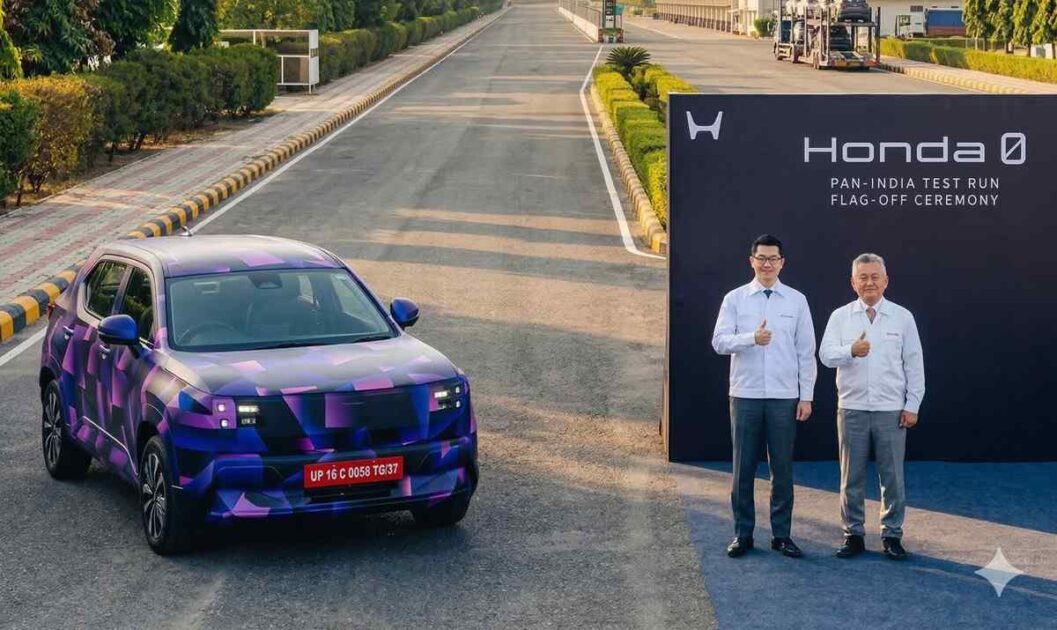

NEW DELHI — Honda Cars India launched pan-India public road testing of its Honda 0 Alpha electric SUV prototype from its Tapukara, Rajasthan plant on March 16, 2026, according to the company’s official press release, days after the Japanese automaker confirmed the cancellation of three EV models planned for North America and disclosed potential losses of up to ¥2.5 trillion ($15.7 billion).
The timing is no accident. While Honda Motor Co. dismantles what was once a seven-model global EV roadmap, India is quietly absorbing the wreckage — emerging as the last viable geography in the company’s electric vehicle ambitions.
Honda’s India EV Bet Stands Alone
Every other EV Honda had announced for volume production is now gone. The 0 Series SUV, the 0 Series Saloon, and the Acura RSX were cancelled on March 12, just months before they were scheduled to enter production at Honda’s Ohio EV Hub in Marysville, Ohio, according to Honda’s official global announcement. The company had already retooled three Ohio facilities and launched a joint-venture battery plant with LG Energy Solution for those models. The Ohio infrastructure stays. The cars do not.
The 0 Alpha, by contrast, sits on a separate, more compact development track — designed for affordability and local manufacturing from the start. Documents reviewed by this publication confirm the Tapukara plant will produce the model locally, backed by a committed investment of approximately ₹1,200 crore. A prototype draped in purple camouflage wrap completed its formal flag-off ceremony on March 16 with executives in attendance on a red-carpeted stage — an unusually visible public staging for what is still a pre-production test phase.
₹1,200 Crore in Rajasthan, Zero in Ohio
Rajasthan Chief Minister Bhajanlal Sharma met Honda Cars India President and CEO Takashi Nakajima at the Chief Minister’s Office to personally confirm the manufacturing commitment. “Production of Honda’s first EV model, Honda 0 Alpha, is set to begin at the Tapukara plant,” Sharma said in a post on X, naming the ₹1,200 crore investment directly.
What mainstream coverage has underplayed: according to statements examined by reporters from CNBC-TV18 and Autocar India, production at Tapukara is expected to begin before the end of 2026 — meaning Honda intends to move from road prototype to full factory output in under nine months. That is an aggressive timeline for a company simultaneously absorbing a historic financial blow.
Nakajima said the testing programme reflects “Honda’s global engineering strengths combined with a strong focus on local customer needs.” He did not say when the consumer launch would happen.
The Prototype Faces India’s Hardest Roads
The Public Road Verification programme covers an ambitious range of conditions. Engineers will push the prototype across:
- Highways, city streets, and challenging off-road terrain
- Extreme summer heat and monsoon conditions
- Multiple charging infrastructure types to assess everyday practicality
- Durability, ride comfort, handling, efficiency, and reliability benchmarks
The battery pack remains officially unconfirmed. Industry data examined by reporters — including specifications reported by CarWale and India Today Auto — suggests either a 60 kWh or 70 kWh pack, with a single-motor front-wheel-drive configuration at launch. Honda has not confirmed either figure.
A $15.7 Billion Collapse in Context
Honda’s projected charges of up to ¥2.5 trillion, detailed in a revised financial forecast published March 12, include:
| Category | Projected Range |
|---|---|
| Operating expenses | ¥820B – ¥1.12 trillion |
| Equity method losses | ¥110B – ¥150B |
| Special non-consolidated losses | ¥340B – ¥570B |
| Total potential impact | Up to ¥2.5 trillion (~$15.7B) |
The Financial Times reported this would mark Honda’s first annual net loss since becoming a public company in the 1950s. Senior executives have agreed to return up to 30% of their compensation. The company blamed the collapse on three converging pressures: US tariffs hitting gasoline and hybrid vehicle margins, the Trump administration’s rollback of EV purchase incentives, and an accelerating shift in China toward software-defined vehicles with shorter development cycles that Honda acknowledged it “was unable to match.”
The fate of the Sony Honda Mobility Afeela 1 sedan — which was designed to share the Ohio assembly facilities and core components with the cancelled 0 Series models — remains unconfirmed. WardsAuto reported it had reached out to Sony Honda Mobility for clarification; no response had been received at time of publication.
Why India Survived the Cuts
Honda’s own revised strategy documentation, reviewed by reporters, states the company plans to “expand its model lineup and improve cost competitiveness in markets such as India and other parts of Asia where growth opportunities remain strong.” That language — buried in the financial forecast — is the clearest signal yet that India is not just a market of convenience. It is now the anchor of whatever Honda’s EV future actually looks like.
The 0 Alpha concept debuted at the Japan Mobility Show 2025. Its survival while costlier, more complex North American models were cancelled reflects a deliberate pivot toward lower-cost platforms in high-growth markets — a playbook being used, with varying results, across the global auto industry.
Honda has said it will detail its full long-term automotive strategy in May 2026. That presentation will determine whether the Tapukara investment anchors a broader Asian EV push or remains a single data point in an otherwise retreating strategy.
