

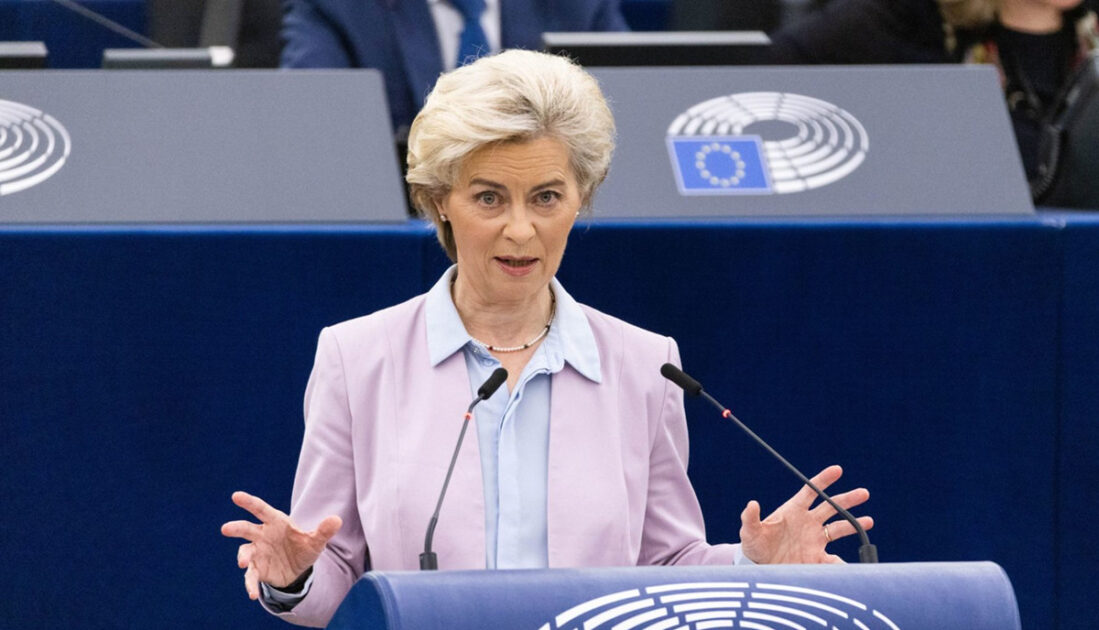

BRUSSELS, BELGIUM — European Commission President Ursula von der Leyen announced Thursday in Brussels that the EU will formally propose cutting electricity taxes and expanding state aid rules across member states, according to a Reuters-reported statement delivered at a summit press conference, with the immediate goal of reducing household and industry energy costs spiking from the ongoing U.S.-Israeli war on Iran.
The announcement cuts through weeks of EU-level deliberation. Europe’s physical gas supply remains technically secure, von der Leyen said — but that framing masks the real damage already done. The first 10 days of the conflict pushed up fossil-fuel import costs by €3 billion across the bloc, by her own count. Energy prices are still moving. The crisis is not paused.
The people feeling it most are households and factory workers in countries that have no alternative but to import gas. Germany, Italy, and the Netherlands sit at the top of that list. The Iran war cut effective flows through the Strait of Hormuz and knocked out Qatari LNG supplies that covered nearly 20% of global LNG trade. That’s not a short-term blip — it’s a structural supply hole.
EU’s Electricity Tax Disparity Drives Proposal
Here’s the part most outlets buried: this isn’t just a crisis response. Documents reviewed by this publication from von der Leyen’s pre-summit letter to EU heads of state show the Commission had already flagged a pre-existing structural flaw — in many EU countries, electricity carries a tax burden up to 15 times higher than gas. One member state applies a 0% electricity tax. Others charge over 16%. That gap has been sitting there for years. The Iran shock finally made it politically untenable.
“In some cases, electricity is taxed much more than gas — up to 15 times more. And this cannot be so,” von der Leyen said at the March 20 press conference, in remarks reviewed by reporters.
Germany is where the pressure shows up most clearly in economic data. Finance experts at major German institutions told Clean Energy Wire that the Iran-driven energy shock is materially increasing recession risks for the country’s already struggling industrial base. Chemical manufacturers in Germany’s east — like SKW Piesteritz in the state of Saxony-Anhalt — say the price surge for natural gas, their core raw material for fertilizer production, is pushing their cost structure to the breaking point. “These price jumps are threatening if the prices for the main raw material cannot be passed on to customers,” Markus Bosch, the company’s spokesman, said.
€30 Billion ETS Booster Targets Industry, Not Households
The headline policy has a fine-print problem that mainstream coverage consistently glosses over. The €30 billion ETS investment booster — funded through 400 million Emissions Trading System allowances — is explicitly designed for industrial decarbonization projects, not immediate relief for households. It helps steel plants and chemical makers retool away from gas. It does not lower a family’s electricity bill next month.
That distinction matters because the political pressure driving the announcement comes from voters, not factory owners. Bank of France Governor François Villeroy de Galhau said publicly what most officials won’t: “We don’t have any more money”. Member states face a political demand to act and a fiscal reality that limits how far they can go.
Officials familiar with state aid implementation confirmed what the formal announcement left vague — member states must individually adopt and apply both the tax changes and the expanded aid rules. The Commission proposes. The 27 member states decide. That gap between announcement and execution is where relief goes to wait.
Spain Acts Unilaterally With $5.7 Billion Package
Spain didn’t wait for Brussels. Prime Minister Pedro Sánchez unveiled a $5.7 billion national relief package on March 19, including fuel subsidies of up to €0.30 per litre and direct aid for transport and agriculture sectors — framing the Iran war explicitly as “illegal” in his public remarks, according to Anadolu Agency.
Spain’s unilateral move underscores a tension the EU summit didn’t fully resolve: member states with larger fiscal capacity are already moving faster than the Commission’s proposal process allows. Countries with tighter budgets — and historically higher electricity tax rates — will take longer to implement cuts, meaning the relief timeline varies sharply across the bloc.
The Iran war began in earnest on February 28, when U.S.-Israeli strikes triggered retaliatory attacks on regional energy infrastructure. Europe entered the crisis with gas storage at 46 billion cubic metres — well below the 60 bcm recorded at the same point in 2025, according to data reviewed by Bruegel’s March 2026 assessment. That storage deficit left the bloc with almost no buffer when supply lines tightened.
Von der Leyen also raised the question of nuclear. Her pre-summit letter explicitly noted that avoiding premature decommissioning of existing nuclear plants — which deliver low-cost, low-emission electricity — “can also play an important role” in managing the crisis. Several EU member states are reconsidering scheduled closures. Whether that translates into policy before winter 2026-27 remains unconfirmed.
The Commission is expected to publish the formal legislative proposal on electricity tax reform in the coming weeks. No binding timeline has been confirmed. What happens between now and then — to prices, to supply lines, to the conflict itself — nobody is saying publicly.
