

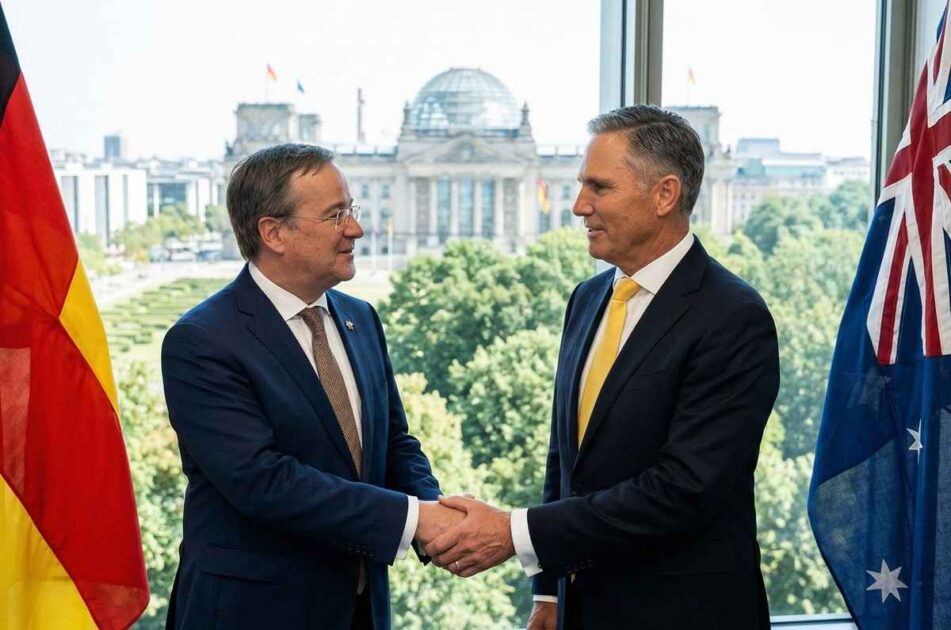

Germany and Australia signed a letter of intent on March 26, 2026, to deploy space surveillance sensors on Australian soil — part of a broader German-led global early warning network aimed at countering Russia and China’s growing capability to jam, blind, and destroy satellites.
CANBERRA, AUSTRALIA — German Defence Minister Boris Pistorius and his Australian counterpart Richard Marles signed a letter of intent on March 26 at Parliament House in Canberra, agreeing to station German space surveillance sensors in Australia as part of what Berlin describes as an independent global monitoring network, according to the Australian Department of Defence’s official joint statement.
The sensors are the operational core of a €35 billion German investment in space systems planned over the coming years — a budget that includes building an “independent global network of surveyors and sensors,” which Pistorius described directly as “an early warning system for space.” What most wire reports have reduced to a diplomatic handshake is, in practice, a physical expansion of European military infrastructure into the Indo-Pacific — the first formal agreement of its kind between the two countries.
Russia and China can now jam signals, blind optical sensors, or deploy kinetic weapons to physically destroy satellites in orbit, Pistorius confirmed at the joint press conference. “We need to be aware of what is going on up there,” he said. “This is the only way to protect our own systems.” The threat is not theoretical: both nations have demonstrated anti-satellite capability in recent years, with debris from past tests still littering orbital lanes used by commercial and military operators globally.
Australia’s geographic position is the reason it was chosen as a sensor host. Its southern hemisphere location and wide, low-interference landmass offer unobstructed visibility over orbital corridors that European ground stations cannot adequately cover. The letter of intent formalizes Australia as part of Germany’s planned global sensor grid — though the exact number of planned sensor sites and their specific locations were not disclosed publicly.
The two ministers also agreed to pursue a Status of Forces Agreement (SOFA), which would reduce bureaucratic and legal barriers to deploying soldiers in each other’s countries. Such agreements typically govern legal jurisdiction over visiting troops, customs clearances for military equipment, and access to bases — details that currently require case-by-case diplomatic handling and create operational delays.
Defence industry cooperation
On the weapons side, Australia will receive warhead components from German missile manufacturer TDW for Joint Strike Missiles and Naval Strike Missiles being manufactured domestically in Australia as part of Canberra’s Guided Weapons and Explosive Ordnance enterprise, in partnership with Norwegian firm Kongsberg. The arrangement is designed to hedge against supply chain disruption — the Ukraine and Middle East conflicts have already strained global munitions production, and Australia has been accelerating local manufacturing to reduce reliance on external suppliers.
Discussions in Canberra also included a meeting with Australian defence firm Electro Optic Systems (EOS), the developer of the Apollo high-energy laser weapon. The system is portable, housed in a standard container, and scalable between 50 and 150 kilowatts — capable of destroying between 20 and 50 drones per minute. Pistorius acknowledged that Germany was “exploring the whole market” for laser weapon solutions, a signal that Berlin has not yet committed to a domestic system and views Australian technology as a genuine contender.
Pistorius’s visit to Australia concluded an Asia-Pacific tour that also included Japan and Singapore — a deliberate geographic arc that underlined Berlin’s position that European and Indo-Pacific security are inseparable. He travelled with senior officials from Germany’s largest defence companies, a delegation structure that signals industrial intent alongside diplomatic agreement.
What the agreements do not yet resolve is the timeline. Letters of intent are legally non-binding commitments. The SOFA still needs to be negotiated and ratified. The sensor deployments require site selection, construction, and integration into Germany’s broader surveillance network — a process that, given the scale of the €35 billion investment, will unfold over years rather than months.
That gap between announcement and operational reality is where Australia and Germany’s ambitions face their hardest test. Both Russia and China continue expanding their anti-satellite capabilities now — not in five years. If the sensor network takes a decade to build, it may be tracking an orbital threat environment that has already changed beyond recognition.
