


Iran’s Islamic Revolutionary Guard Corps has quietly turned the world’s most critical oil chokepoint into a toll booth — charging up to $2 million per ship, routing vessels through a 5-mile IRGC-controlled corridor, and accepting payments in cash, cryptocurrency, or barter. The diplomacy is heating up, but the mechanism itself has gone largely unexplained.
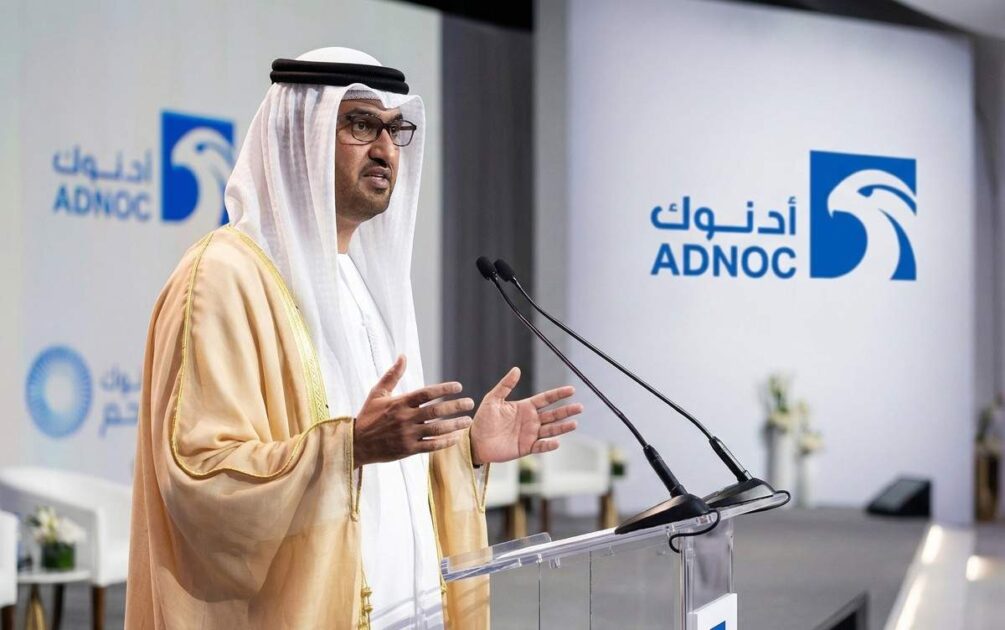
HOUSTON / ABU DHABI — ADNOC Managing Director and Group CEO Dr. Sultan Al Jaber declared this week that Iran’s control over the Strait of Hormuz constitutes “economic terrorism against every nation,” as newly confirmed intelligence data revealed the Islamic Revolutionary Guard Corps (IRGC) has established a structured toll system requiring ships to pay up to $2 million per transit — with oil prices having surged 50 percent in three weeks, according to an ADNOC press release and Lloyd’s List Intelligence tracking data.
The blunt language from one of the Gulf’s most senior energy executives reflects how far the crisis has moved beyond a supply disruption into something more structurally alarming: Iran is no longer just threatening closure — it is monetising passage.
The Toll Booth System, Explained
Since March 13, every one of the 26 vessels tracked by Lloyd’s List Intelligence transiting the strait has followed a single IRGC-approved corridor — a 5-mile channel running between the islands of Larak and Qeshm, past an IRGC naval base. No vessel has used the normal shipping route since March 15, according to Lloyd’s List Intelligence.
To receive clearance, ship operators must submit:
- Full ownership chain and beneficiary structure
- Complete cargo manifests
- Crew nationalities
- Destination port documentation
That data is then passed to IRGC-affiliated intermediaries operating outside Iran, who grant or deny transit approval. Vessels receive a clearance code and an armed IRGC escort for passage. At least one confirmed transaction put the fee at approximately $2 million, paid through a combination of cash, cryptocurrency, and barter, according to Lloyd’s List and the Financial Times. The payments are settled in yuan in at least some recorded cases.
Vessels linked to the United States or Israel are excluded from transit entirely.
The IRGC is now building a formal registration system to replace current case-by-case approvals. India, Pakistan, Iraq, Malaysia, and China are in active talks with Tehran to secure dedicated transit arrangements for their national carriers, according to the gosships.com analysis citing Lloyd’s List and Financial Times reporting.
What Al Jaber Said – and What He Didn’t
Speaking at CERAWeek in Houston on March 23, Al Jaber was direct: “This is not a supply issue. It is a security issue, and it has only one durable answer — keeping the Strait open.”
At the Middle East Institute’s 80th Anniversary Gala in Washington two days later, he sharpened the framing for a political audience: “When Iran holds Hormuz hostage, every nation pays the ransom,” he said, according to Gulf News.
What neither speech addressed openly is the specific mechanism that Lloyd’s List has now confirmed: that passage is not simply being denied — it is being sold. The distinction matters enormously. A blockade can be challenged militarily or diplomatically. A toll system, once normalised through government-to-government agreements with countries like India and China, becomes progressively harder to dismantle.
Al Jaber also met US Vice President JD Vance at the White House, where both sides aligned on the principle that “energy security equals global security.” No concrete action timeline was announced.
The Real Cost, By the Numbers
Tanker transits through the strait have dropped roughly 92 percent compared to the week before the conflict began on February 28, according to Kpler vessel-tracking data cited by The National. Normally, approximately one-fifth of the world’s oil and gas supply — and around 3,000 ships per month — passes through the waterway, according to economic analysis published by the Economic Times.
Oil prices have risen 50 percent in three weeks, according to ADNOC. Some analysts at Goldman Sachs, cited by the Economic Times, have warned prices could reach $215 per barrel if disruptions persist without a diplomatic resolution.
The impact is already measurable in Asia. South Korea, Japan, and India — which collectively depend heavily on Gulf crude — face elevated import costs that will filter through to fuel, electricity, and manufacturing prices over the coming weeks.
The harder question now is not whether the strait is weaponised — it clearly is. It is whether the international community can respond coherently when five major economies are already negotiating individual access deals with Tehran, each one quietly validating a system that the UAE and the United States are publicly condemning. The toll booth does not need universal acceptance to become permanent. It only needs enough clients.
