
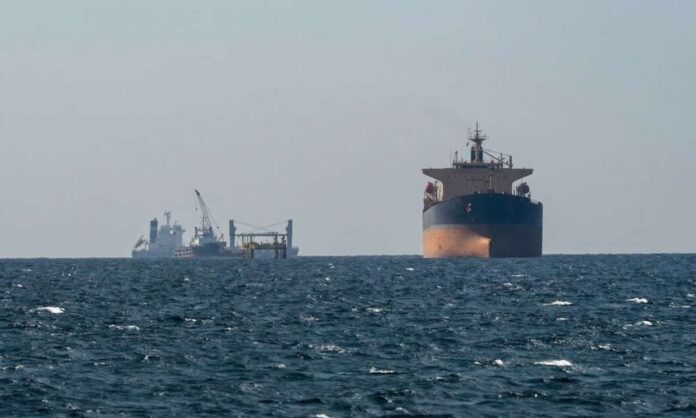
LONDON, UNITED KINGDOM — The governments of the United Kingdom, France, Germany, Italy, the Netherlands, and Japan issued a formal joint statement on Thursday, March 19, 2026, declaring their collective readiness to contribute to securing safe passage through the Strait of Hormuz, according to a statement reviewed by reporters from multiple wire agencies, as Iran’s effective blockade of the world’s most critical oil waterway continues to destabilize global energy markets.
The declaration marks a significant reversal. As recently as March 15, allied nations had balked openly at US President Donald Trump’s demand that they dispatch warships to the region, with Germany, Japan, and others expressing caution about direct military engagement. That ambiguity is now gone — though the statement stops well short of committing specific vessels, timelines, or troop numbers, a detail no major outlet has foregrounded.
Iran’s Hormuz Blockade Rocks Energy Supply
The stakes are not abstract. The Strait of Hormuz handles roughly 20 million barrels of crude oil per day — approximately 20% of the global oil supply — along with a significant share of the world’s liquefied natural gas (LNG) trade, according to IEA data. Since February 28, Iran’s Islamic Revolutionary Guard Corps has mined the waterway, deployed armed drones, and launched missile strikes on commercial vessels, effectively closing it to most shipping.
The affected groups span every continent. Consumers in Europe, Asia, and South Asia face direct fuel price pressure. Japan sits at the sharpest end of the exposure: the country depends on the Middle East for approximately 95% of its oil imports, with around 70% of those shipments — and 6% of its LNG — transiting directly through the Strait, according to a Reuters analysis of government energy data published March 4, 2026. As of early March, leading Japanese utility companies had boosted LNG reserves by 10% to reach 2.19 million metric tons — roughly 12 days of national consumption.
The Fine Print in Thursday’s Joint Statement
The joint statement, issued simultaneously in London and coordinated with Tokyo’s foreign ministry, condemns in explicit language Iran’s “attacks on unarmed commercial vessels in the Gulf, attacks on civilian infrastructure including oil and gas installations, and the de facto closure of the Strait of Hormuz by Iranian forces.” It calls on Tehran to comply with UN Security Council Resolution 2817, adopted on March 11, 2026, with 135 co-sponsors — the highest number ever recorded for a Security Council resolution.
What’s buried: the statement uses the phrase “readiness to contribute to appropriate efforts” — carefully chosen language, officials familiar with the deliberations noted, that preserves national flexibility on the exact form of military contribution. Mine-clearing operations, in particular, represent a specific military bottleneck. Retired General Nick Carter, former chief of Britain’s Defence Staff, told the BBC that Western militaries have not prioritized mine-clearing in their naval strategies, making any convoy escort mission substantially more complex than the headline suggests.
IEA’s Emergency Release Falls Short of Full Gap
The joint statement explicitly welcomed the International Energy Agency’s decision to release strategic petroleum reserves and pledged “other steps to stabilise energy markets, including working with certain producing nations to increase output.” The IEA’s 32 member countries agreed on March 11 to release a record 400 million barrels of emergency crude — more than double the 182 million barrels released after Russia invaded Ukraine in 2022, according to Al Jazeera’s reporting on the IEA’s announcement.
That release, however, equals only roughly four days of global oil production and about 16 days of the volume normally transiting the Strait, according to Macquarie analysts. IEA Executive Director Fatih Birol acknowledged publicly that restoring stable oil and gas flows ultimately hinges on physically reopening the waterway — not just tapping reserves. Brent crude remains above $90 per barrel as of this week.
Where Asia and Europe Diverge on Risk
The six-nation alliance does not include every exposed economy. South Korea, which sources around 70% of its oil from the Middle East, is absent from the statement. So is India, which faces its own crude import pressures. China, which Trump publicly urged to participate on March 15, has not joined any security framework around the strait, citing its longstanding non-interference policy.
Japan, by contrast, confirmed its intent through a separate diplomatic track. Foreign Minister Toshimitsu Motegi told counterparts in the Gulf region that Tokyo would work with the US and other allies for “safe navigation in the Strait of Hormuz,” according to Japan Today. The commitment represents a notable shift for Japan, which has historically avoided direct military involvement in Middle Eastern conflicts due to post-war constitutional constraints.
The CGTN Europe account on X published the full joint statement text on Thursday:
The text confirms the six nations welcome “the commitment of nations who are engaging in preparatory planning” — language that signals active coalition-building without specifying which nations are doing the planning.
Resolution 2817 Sets Legal Framework
The UN Security Council’s Resolution 2817, passed March 11 under Chapter VII of the UN Charter, provides the explicit legal underpinning for Thursday’s allied declaration. The resolution determines that any attempt to impede lawful transit through the Strait of Hormuz constitutes a threat to international peace and security — a finding that, under Chapter VII, opens the door to the Council authorizing use of force if diplomatic measures fail. Bahrain introduced the resolution on behalf of the Gulf Cooperation Council and Jordan, drawing a coalition of 135 co-sponsors in a bloc reflecting both regional self-interest and global concern over supply disruption.
The practical timeline for any military deployment remains unspecified. The coalition’s statement uses “preparatory planning” language — suggesting the months-long logistics of mine-clearing, convoy coordination, and rules of engagement are still being worked out behind closed doors. A source with knowledge of EU security discussions declined to confirm whether a formal mission mandate has been agreed upon.
