
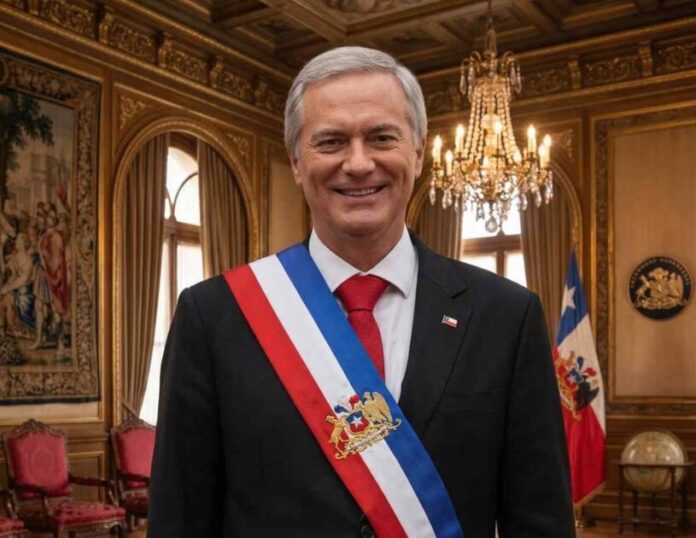
SANTIAGO, CHILE — José Antonio Kast took the oath of office as Chile’s president on March 11, 2026, in Valparaíso, according to official government records, marking the country’s most dramatic rightward turn since the restoration of civilian rule in 1990 — and handing Washington its most ideologically aligned Latin American partner in a generation.
Kast swept December‘s runoff election with 58.2% of the vote, a margin of more than 16 percentage points over Communist Party candidate Jeannette Jara, according to Chile’s electoral authority results. The win was not close. It was a mandate. And within 24 hours of his inauguration, the US and Chile had already signed a joint declaration on critical minerals and rare earth cooperation, according to a March 12 statement reviewed by JD Supra and confirmed by the US State Department.
The speed of that agreement says something. US Deputy Secretary of State Christopher Landau had already traveled to Santiago on March 8 — three days before Kast was even sworn in — to begin resetting the bilateral relationship, per the State Department.
Kast’s Three Priorities Put Washington First
Kast entered La Moneda palace with a tight, publicly stated 90-day plan built around three pillars:
- Security — cracking down on organized crime through his Plan Implacable, which includes tougher prison regimes, expanded law enforcement powers, and military reinforcement of the northern border
- Immigration — mass deportations of undocumented Venezuelan migrants and a Plan Escudo Fronterizo (border shield) to restrict irregular crossings
- Economy — a 3% permanent spending cut across all ministries and a proposed corporate tax reduction from 27% to 23%
All three align tightly with the current US administration’s hemispheric agenda. Nicholas Watson, a Latin America analyst cited by Reuters, put it plainly: “Speedy and effective delivery on his three priority issues — security, immigration, and the economy — will be essential.”
Officials familiar with the Kast transition told Americas Quarterly that Chile considers the US its most vital strategic and security partner across four decades of bilateral ties — a relationship now expected to deepen rapidly under shared ideological ground.
The China Problem Nobody Is Solving
Here is the part most inauguration-week coverage buried in its final paragraphs.
China accounts for 40% of Chile’s total exports and 25% of its imports, according to Americas Quarterly’s post-inauguration analysis published March 13. Total Chile-China trade reached $58.5 billion in 2024, according to trade data reviewed by this publication, driven primarily by $21.3 billion in copper concentrate exports and another $5.4 billion in copper cathodes flowing to Chinese smelters annually.
Chinese state-owned enterprises also control a significant portion of Chile’s electrical grid, a structural dependency that no diplomatic declaration erases overnight, as the New York Times reported on March 12.
Kast moved symbolically before taking office — blocking a submarine cable deal that would have linked Chile to China during the presidential transition period, per NYT reporting. But symbolic is the operative word. Researchers have found no formal legislative proposal that would limit Chinese infrastructure ownership or redirect copper export flows toward US buyers.
| Trade Partner | Share of Chile’s Exports | Share of Chile’s Imports |
|---|---|---|
| China | 40% | 25% |
| United States | 15% | 20% |
The gap in that table is the real story of Kast’s foreign policy challenge.
A Parliament That Won’t Simply Comply
Documents reviewed from the Atlantic Council’s pre-inauguration briefing — published December 21, 2025 — flag a structural barrier that inauguration coverage consistently downplayed: Kast’s major legislative agenda, including mass deportations, requires a majority in a Senate that is evenly split.
His lower chamber majority gives him room on budget cuts and some security decrees. It does not give him the votes for transformational policy without building coalitions with traditional right and swing-actor legislators who may resist the most aggressive proposals. The Atlantic Council briefing noted directly that passing landmark legislation will require Kast to negotiate with actors well outside his ideological base.
Crime costs Chile nearly $8 billion annually, according to researcher estimates cited in the same briefing, a figure that explains the public’s appetite for his security agenda — but public appetite and Senate arithmetic are different problems.
Latin America’s Conservative Realignment — and Its Limits
Kast is not operating in isolation. His inauguration in March came one week after he hosted a regional summit in Miami with conservative leaders from across Latin America, where drug trafficking and security cooperation dominated the agenda, per NYT reporting. Argentina’s Javier Milei and Ecuador’s Daniel Noboa represent a broader ideological wave that Washington is actively cultivating.
But Milei faces the same structural contradiction. Argentina, like Chile, has deep economic dependencies on Chinese trade and investment that ideology alone cannot dissolve. Whether Kast will genuinely limit China’s operational footprint in Chile’s energy sector — versus merely adjusting the rhetorical temperature — remains unconfirmed. This publication was unable to reach Kast’s foreign ministry for comment on any concrete timeline for reviewing existing Chinese infrastructure contracts.
What is confirmed: Chile and the US signed their joint critical minerals declaration on March 12, one day after the inauguration, signaling that lithium and copper supply chain cooperation is the immediate bilateral priority — a direct counter to China’s dominance in battery-supply-chain minerals.
The Kast administration’s 90-day plan expires in June 2026. Whether his security decrees have produced measurable results by then will determine whether his legislative coalition holds — and whether Washington’s newest Latin American ally has the domestic stability to deliver on the strategic partnership both governments are publicly celebrating.
What nobody has confirmed yet is whether any formal review of Chinese state-owned enterprise contracts in Chile’s electricity sector is even on the table.
