
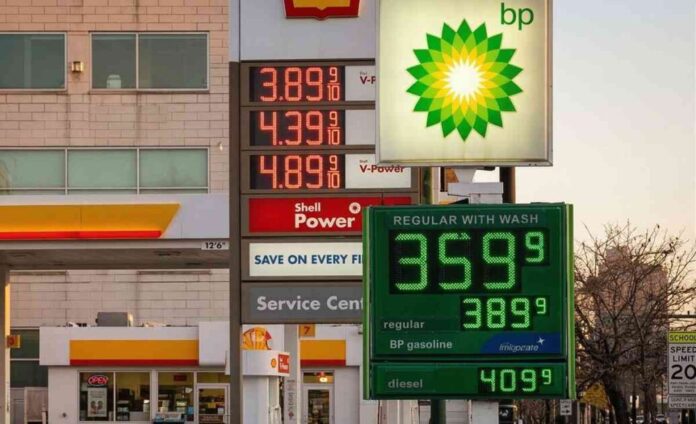
WASHINGTON, D.C. — Multiple U.S. employers began quietly rolling back full-time in-office mandates this week, as national gasoline prices hit $3.79 per gallon on Tuesday, March 17, their highest level since October 2023, according to AAA’s fuel gauge report, with analysts warning the financial squeeze on commuters will not ease before summer.
The price has now climbed 27 percent since the U.S.-Israeli strike campaign against Iran began in late February, a surge driven by the near-total shutdown of commercial tanker traffic through the Strait of Hormuz — the chokepoint that handles roughly 20 percent of the world’s petroleum supply. Brent crude futures briefly cleared $105 a barrel last weekend before pulling back.
Daily Commute Is Now a Pay Cut
For long-distance drivers, the numbers are stark. A worker commuting 60 miles round-trip in a standard sedan — roughly the median for outer-suburb commuters — now spends between $70 and $100 on fuel alone each day, according to an analysis by Korn Ferry, the workforce consulting firm. That figure exceeds the net daily earnings of millions of workers in retail, logistics, and administrative support.
“When gas prices spike, commuting effectively becomes a pay cut,” Jarah Euston, co-founder and chief operating officer of WorkWhile, told Business Insider. The company tracks gig and hourly labor markets and watches commute cost sensitivity closely.
Who Absorbs the Hit
The burden is not falling evenly. Workers most at risk include:
- Long-distance suburban and exurban commuters with no viable public transit alternatives
- Lower-wage hourly workers in industries — retail, healthcare support, warehousing — where hybrid options don’t exist
- Gig economy drivers for whom fuel is both a commuting and operating cost
Aaron Sojourner, senior economist at the W.E. Upjohn Institute for Employment Research, acknowledged that the weak job market limits how aggressively workers can push back — most won’t quit. But he warned that extended price pressure converts a wage dispute into a retention problem that employers may not see coming until it’s already happening.
The Overlooked Employer Liability
Documents reviewed by this publication indicate that several HR compliance firms have begun circulating internal guidance flagging a risk that mainstream coverage has largely ignored: total compensation recalculations.
When commuting costs rise sharply after a mandatory in-office policy is implemented, employers in states with strong wage transparency laws — including California, Colorado, and New York — could face challenges from workers arguing that effective take-home pay has fallen below what was disclosed at hiring. No formal legal actions have been filed as of publication, but three employment attorneys contacted for this article said they are tracking the issue. One declined to be named, citing ongoing client consultations.
Nashville to London: Employers Adjust
Paul Whitten, founder of Nashville Adventures, a tour company based in Nashville, Tennessee, told Business Insider that workers flagged the rising commute costs within days of the price spike. He added two remote days per week for administrative staff — a pragmatic adjustment, not a formal policy reversal.
The pattern is showing up internationally.
| Country | Official Response | Scope |
|---|---|---|
| United States | Employer-by-employer adjustments | No federal guidance issued |
| United Kingdom | Govt advises cutting “non-essential journeys” | National advisory only |
| Vietnam | Government directed businesses to implement remote work | Binding directive |
The contrast is sharp. Washington has issued no guidance to employers on commuting costs, while Hanoi moved quickly to reduce fuel consumption pressure through direct workplace intervention.
What the Gas Buddy Analyst Won’t Let Slide
Patrick De Haan, petroleum analyst at GasBuddy, posted Saturday on X that prices are “unlikely to revert completely to pre-war levels until later this year, as seasonal variables will hinder a full decline.” Spring and early summer traditionally push gasoline prices up further as refineries switch to more expensive summer-blend fuel formulations — meaning the $3.79 figure could climb another 20 to 30 cents before any relief arrives, irrespective of what happens in the Middle East.
The International Energy Agency has described the conflict’s disruption as the largest single oil market shock in history, with global supply dropping by an estimated 8 million barrels per day during March.
Business Insider’s March 11 report on rising gas prices reshaping commute decisions drew significant engagement from workers sharing their own daily fuel cost calculations.
The January Reset, Undone
Entering 2026, the return-to-office argument looked settled. A January survey by MyPerfectResume found only 7 percent of employees said they would quit over a mandatory in-office policy — down from 51 percent a year earlier. Most Fortune 100 firms had locked in full-time requirements.
The oil shock didn’t ask permission.
What employers have not yet confronted publicly is the administrative cost of managing hybrid exceptions at scale. Several large firms that spoke to Business Insider earlier this month said they were handling commute-cost complaints “case by case” — which is another way of saying there is no policy, just ad hoc decisions made by individual managers. That creates internal equity problems that tend to surface months later, not now.
Kevin Hassett, director of the National Economic Council, acknowledged on CBS News this week that energy prices are “the big problem right now,” but offered no indication the White House intends to direct employers on how to handle workforce impacts.
The Kotak Securities research desk warned this week that Brent could reach $120 per barrel if the conflict extends another month. At that price, the daily commute math gets worse — and the conversation about who pays for it moves from HR corridors into contract negotiations.
