
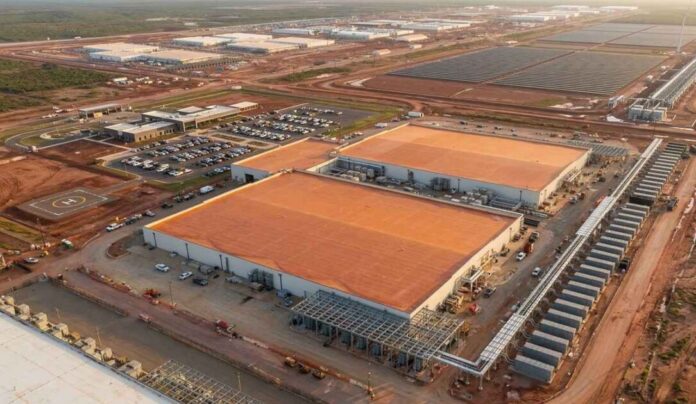
SAN FRANCISCO — OpenAI has quietly abandoned its ambition to own the data centers powering its Stargate initiative, instead locking in a $50 billion deal with Amazon Web Services to rent computing capacity — a reversal that exposes deep cracks in the $500 billion AI infrastructure project announced with much fanfare at the White House in January 2025, according to reporting by The Information and confirmed by official statements reviewed by this publication.
The shift didn’t happen by design. It happened because OpenAI couldn’t get the financing it needed.
OpenAI’s Stargate Financing Falls Apart
Shortly after President Donald Trump stood beside OpenAI CEO Sam Altman at the White House to announce Stargate, the company’s infrastructure team fanned out across the country scouting sites capable of supporting campuses between 800 megawatts and 1.2 gigawatts each. Executives reportedly floated spinning Stargate out as a separate financial vehicle — a structure that would allow the company to raise capital for chips and infrastructure without putting it on OpenAI‘s own balance sheet.
That plan collapsed. OpenAI could not secure financing on competitive terms to own the facilities outright, according to The Information. Documents reviewed by reporters at Tom’s Hardware confirm the pivot began almost immediately after the January 2025 announcement.
The $50 Billion Rental Deal – and Its Hidden Conditions
On February 26, 2026, Amazon and OpenAI announced what they called a “multi-year strategic partnership.” Under the agreement, Amazon commits $50 billion in investment and OpenAI agrees to consume approximately 2 gigawatts of Amazon‘s custom Trainium compute capacity through AWS infrastructure.
The deal also expands OpenAI‘s prior $38 billion AWS compute agreement — struck in November 2025 — by an additional $100 billion over eight years, according to the official Amazon announcement.
What that press release didn’t headline: $35 billion of Amazon‘s $50 billion commitment is not unconditional. According to sources cited by The Information and reporting by Tom’s Hardware, that portion is contingent on OpenAI either completing an IPO or reaching an undefined “AGI milestone” — a condition that introduces significant uncertainty into the deal’s actual scale. OpenAI has not publicly confirmed those conditions, and the company declined to elaborate beyond its official statement.
Who Controls the Hardware Now
OpenAI‘s strategic answer to losing control of facilities is to seize control of something else: the hardware inside them. Rather than owning data centers, OpenAI now designs and specifies the chip architecture deployed within rented infrastructure, according to reporting by Bloomberg.
The company has been diversifying its chip supply away from Nvidia dependence:
- Amazon AWS: 2 gigawatts of Trainium 3 and Trainium 4 capacity
- AMD: Additional compute capacity under a separate supply agreement
- Cerebras Systems: Supplementary inference workloads
- In-house chip team: Led by Richard Ho, targeting mass production in late 2026, with custom accelerators to be deployed across 10 gigawatts of Stargate capacity
OpenAI‘s total computing capacity more than tripled in 2025 to roughly 1.9 gigawatts, but the gap between current capacity and Altman‘s stated vision — which he has described as potentially requiring trillions in investment — remains vast.
The Abilene Cancellation No One Is Fully Explaining
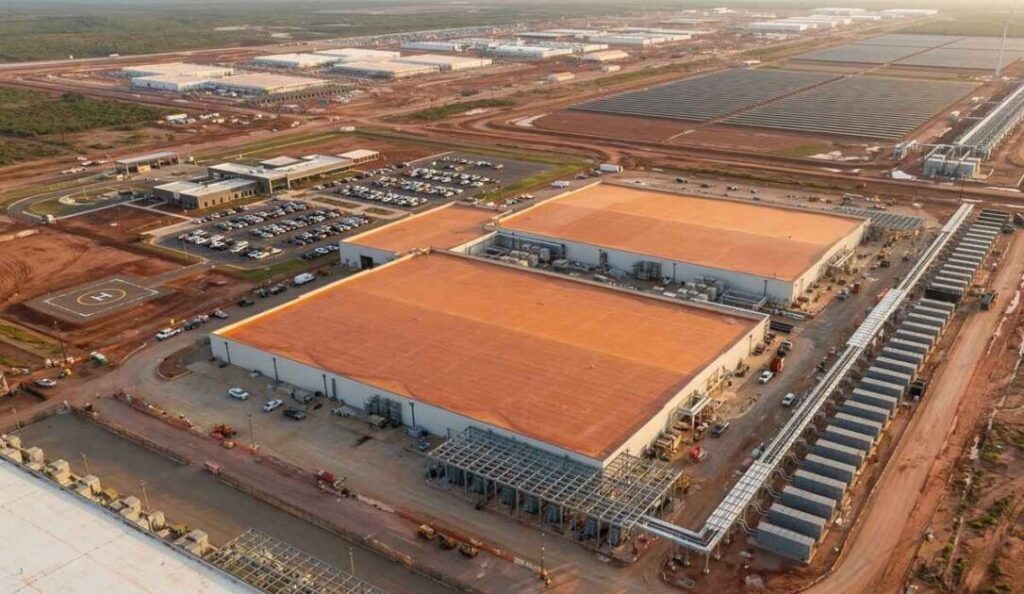
The cracks showed most visibly in Abilene, Texas. OpenAI and Oracle built the flagship Stargate campus there — the first site to break ground, with Oracle overseeing construction of a facility designed to reach 1.2 gigawatts of power capacity.
In early March 2026, both companies quietly scrapped plans to expand the Abilene campus to roughly 2 gigawatts. CNBC reported that OpenAI walked away because it wanted next-generation Nvidia chips at new sites — chips that Oracle‘s Abilene infrastructure wasn’t designed to support.
Sachin Katti, OpenAI‘s head of industrial compute, confirmed the decision on social media, stating the capacity was simply being redeployed elsewhere. But the mainstream framing — that this was a routine reallocation — glosses over something significant: Abilene was the flagship. Walking away from its expansion within roughly 14 months of the project’s announcement signals that the infrastructure strategy is being rewritten in real time.
A Former Academic Now Steering a Trillion-Dollar Buildout
The leadership picture adds another layer of complexity. Keith Heyde, who joined OpenAI from Meta in late 2024 to lead data center site selection and buildout, left the company in early 2026 after spending months evaluating hundreds of proposals for Stargate campuses — an abrupt departure that received little coverage relative to its significance.
Sachin Katti — a former chief technology and AI officer at Intel who spent much of his career as a professor at Stanford University — now serves as head of industrial compute, reporting to OpenAI President Greg Brockman. Bloomberg published a profile of Katti on March 10, 2026, describing him as the “former academic guiding OpenAI‘s trillion-dollar AI buildout.”
Katti oversees data center capacity, chip supply chains, and industrial partnerships. His background is primarily academic and semiconductor strategy, not large-scale construction or real estate development — a distinction that matters when you’re managing what may become the largest infrastructure program in American corporate history.
One thing this newsroom could not confirm: what precisely caused Heyde‘s departure, and whether the strategic pivot from building to renting was a driver. OpenAI did not respond to a request for comment on the timeline of that decision.
The Broader Stargate Project Isn’t Collapsing – Yet
To be clear: Stargate as a concept remains intact. As of February 2026, the initiative targets roughly 10 gigawatts of total AI data center capacity across the United States and internationally, underpinned by Oracle, SoftBank, and a growing web of infrastructure partners. OpenAI and SoftBank each invested $500 million in SB Energy in January 2026 to accelerate power infrastructure development, with the 1.2 GW Milam County, Texas campus targeted to enter service this year.
What has changed is who owns what — and who bears the risk. Under the new model, OpenAI is increasingly a tenant rather than a landlord, betting that controlling hardware design and model architecture matters more than controlling the concrete and steel around it. Whether that bet holds depends partly on whether those $35 billion in contingent Amazon funds ever actually land.
AWS holds approximately 30% of the global cloud market heading into this deal, compared to Azure‘s roughly 20% and Google Cloud‘s 13%, according to data analyzed by Tom’s Hardware. Amazon CEO Andy Jassy described OpenAI as likely to be “one of the very big winners” over the long term — but also confirmed Amazon “still has a very strong relationship with Anthropic.”
OpenAI‘s next confirmed infrastructure milestone is the Milam County, Texas campus coming online in 2026. The company’s broader 10 GW target and the timeline for its in-house chip deployment remain ongoing, with no fixed public deadline confirmed.
