
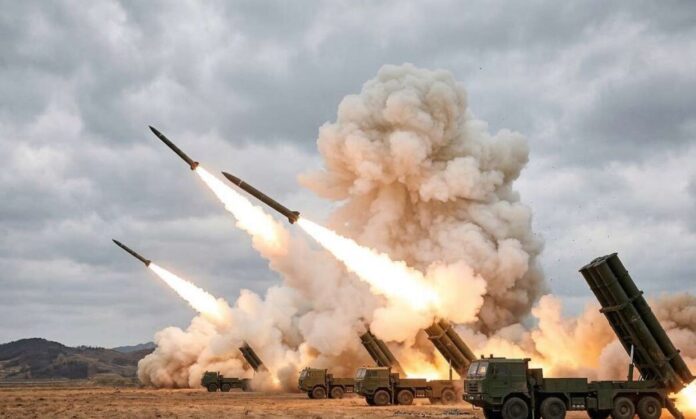
SEOUL, SOUTH KOREA — North Korean leader Kim Jong Un personally oversaw a live-fire salvo of 12 nuclear-capable KN-25 600mm rocket launchers on Saturday, March 14, targeting an island in the East Sea approximately 364.4 km away, according to Korean Central News Agency (KCNA), in the largest single KN-25 volley since May 2025 — timed to coincide with ongoing US-South Korea joint military drills.
Kim’s 420 km Warning Targets All of South Korea
The timing was not accidental. The launches occurred on Day 6 of Freedom Shield, an 11-day combined command post exercise involving roughly 18,000 South Korean troops that runs through March 19, according to South Korea’s Joint Chiefs of Staff.
Kim, flanked by his teenage daughter Kim Ju Ae — roughly 13 or 14 years old and increasingly visible at weapons demonstrations — personally declared that “enemies within the 420 km range” would feel anxiety, a figure that covers every major military installation, port, and civilian population center on the Korean Peninsula south of the border. State media quoted him adding that observers would gain “a deep understanding of the destructive power of tactical nuclear weapons.”
KN-25 Salvo Breaks Near Two-Year Record
This was not a routine test. Official records reviewed by this publication confirm that the last time Kim personally presided over a KN-25 mass salvo was May 8, 2025 — making Saturday’s drill the first such event in nearly 10 months, and the largest single-salvo count confirmed in that stretch.
KCNA claimed 100% strike accuracy against the island target. South Korea’s military, however, detected only “about 10” missiles — a discrepancy that Seoul’s Joint Chiefs declined to publicly explain in their initial statement, according to AP. The gap between Pyongyang’s count of 12 and Seoul’s detection of approximately 10 likely reflects sensor limitations during a rapid salvo launch sequence.
What the “AI Guidance” Claim Actually Means
When Kim unveiled 50 upgraded KN-25 launchers in Pyongyang in February 2026, he claimed the new batch incorporated “AI technology and a combined guidance system.” The reality, experts say, is considerably more modest.
Sam Lair, an analyst with the James Martin Center for Nonproliferation Studies, told NK News that the guidance system is “unlikely to contain artificial intelligence elements” — and that the AI reference likely describes standard onboard computer assistance. Ankit Panda of the Carnegie Endowment for International Peace suggested Kim may have been referring to AI used in the manufacturing process rather than flight guidance.
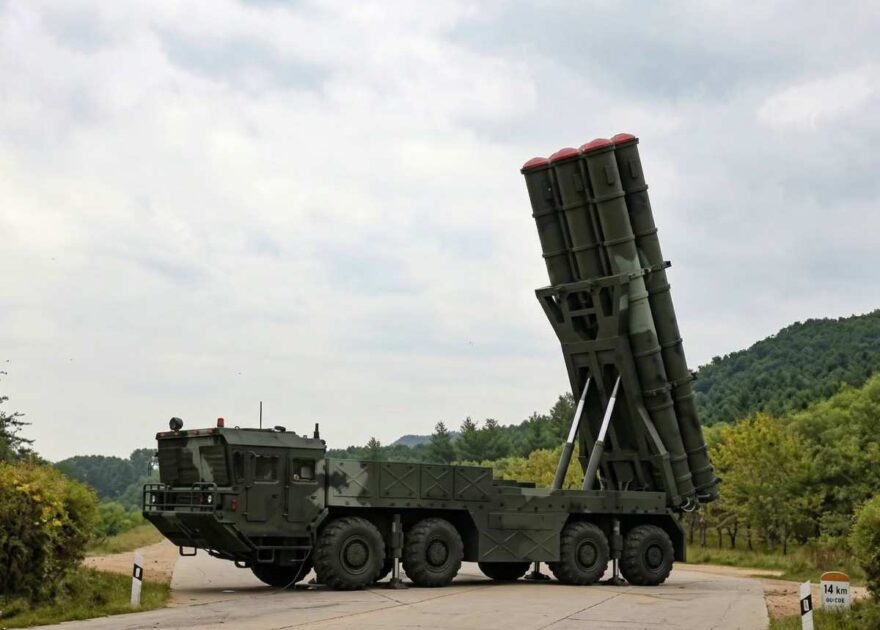
The upgraded launchers carry 5 tubes per vehicle, one more than earlier models, and sit atop a redesigned chassis. South Korea and the US classify the platform as a short-range ballistic missile (SRBM) rather than conventional artillery — a legal and operational distinction that matters for arms-control frameworks.
The Diplomatic Timing Few Outlets Are Covering
Hours before the rockets flew, South Korean Prime Minister Kim Min-seok publicly stated that US President Donald Trump believed a meeting with Kim Jong Un would be “good” — the clearest signal yet of Washington’s appetite for renewed engagement.
Pyongyang responded with 12 rockets. That sequence — diplomatic signal, then firepower — fits a well-documented pattern North Korea uses to signal that any talks must first acknowledge its nuclear status. Kim himself recently said the two countries could “get along” if Washington accepted Pyongyang’s nuclear reality as a baseline condition.
Trump’s planned visit to Beijing in late March has added another layer of strategic calculation: Pyongyang is watching whether a potential US-China summit produces any back-channel pressure to engage, or gives Kim more room to push further. Neither Washington nor Seoul confirmed a response posture as of Sunday.
Seoul Condemns, But the Kill Chain Is the Bigger Problem
South Korea’s government condemned the launches as a “provocation that violates United Nations Security Council resolutions” and called on Pyongyang to stop immediately. The statement was formal. The strategic concern is more concrete.
Shin Jong-woo, secretary-general of the Korea Defense and Security Forum, said the KN-25’s launch-pad upright time is estimated at under one minute — fast enough to execute a “shoot-and-scoot” tactic that moves launchers before US-South Korean targeting systems can respond. “It is a ‘shooting and falling’ tactic to neutralize the kill chain,” Shin said.
That matters because Freedom Shield drills specifically train allied forces to intercept exactly this kind of rapid-strike scenario. Whether those procedures can realistically outpace a 12-launcher simultaneous salvo remains an open question — one that Seoul’s defense ministry has not addressed publicly in the days since the drill.
Kim Yo Jong, Kim’s sister and senior regime figure, warned earlier this week that Freedom Shield exercises “may cause unimaginably terrible consequences.” The rockets that followed were Pyongyang’s operational answer to that warning. Whether Washington adjusts its diplomatic approach — or the drill schedule — before March 19 remains unclear.
