
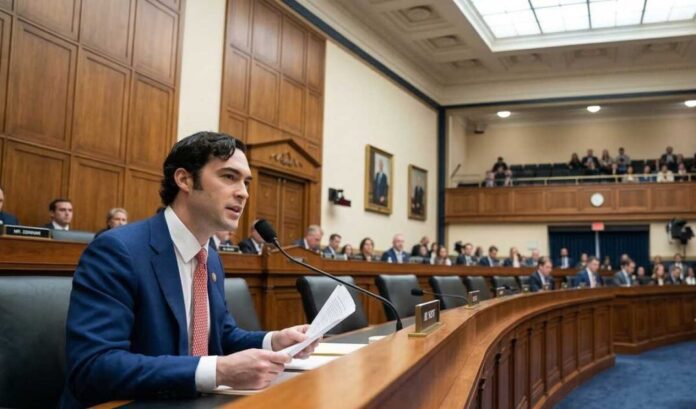
WASHINGTON, D.C. — A bloc of House Republicans formally threatened over the weekend to block all Senate-passed legislation from clearing the lower chamber — exempting only Department of Homeland Security funding — until the Senate takes up and passes the Safeguard American Voter Eligibility (SAVE) America Act, according to statements made on Fox News and posts on social media reviewed by reporters.
The standoff is not symbolic. Senate Majority Leader John Thune, Republican of South Dakota, is expected to call a procedural vote as early as Tuesday, March 17, to formally open floor debate on the elections overhaul bill — but according to Politico’s Capitol reporting from March 16, the bill is “likely doomed thanks to bipartisan opposition and the GOP conference’s desire to protect the filibuster.” The Senate drama could stretch seven to ten days or longer, senators on both sides estimate.
Rep. Anna Paulina Luna, Republican of Florida, and Rep. Brandon Gill, Republican of Texas, delivered the ultimatum directly on Fox News Saturday in America. Luna was blunt: “The Senate will no longer have legislation passed until the SAVE America Act is passed and on the President’s desk.” Gill told the anchor that more than 40 House Republicans back the effort, leaving only DHS funding as a carve-out.
What mainstream coverage buries — and what makes this specific standoff far more consequential than standard Republican infighting — is that the House’s threat kicks in regardless of whether the Senate tries and fails to pass the SAVE Act. Documents reviewed by reporters covering the House leadership discussions confirm that Luna and her allies have signaled even a good-faith Senate attempt is not enough. The bill must reach President Donald Trump‘s desk, or the blockade stands.
Trump himself escalated the pressure on Monday, March 9, telling House Republicans at an event in Florida that he would refuse to sign any other legislation until the SAVE Act clears the Senate. The White House later narrowed that pledge, confirming it would not apply to DHS appropriations. But Trump has also pushed Thune to use a talking filibuster — a procedural tactic that forces the opposition to occupy the floor continuously or yield — a route Thune has publicly resisted, calling it “more complicated and risky than people are assuming at the moment.”
The Senate arithmetic is the story. Republicans hold 53 seats but need 60 votes to break a filibuster under current rules. Sen. Thom Tillis of North Carolina has already signaled he will oppose even the procedural vote to open debate, according to reporting by Politico on March 16 — meaning Thune begins the week with his own conference fraying before the first gavel falls. Sen. Ron Johnson of Wisconsin has conceded the path through a talking filibuster is “nearly impossible,” and Thune himself told reporters there are “not even close” to enough votes to eliminate the legislative filibuster altogether.
The National Association of Counties (NACo) flagged significant administrative concerns in its assessment published March 12, warning that the bill’s documentary proof-of-citizenship requirement for voter registration would create substantial operational burdens for county election administrators — a dimension absent from almost all Republican messaging on the bill. Local officials in several states have privately said the infrastructure to verify documents at scale does not yet exist, according to officials familiar with state-level implementation planning.
The intra-party fracture extends further than the floor count. Trump told House Republicans in Florida that the current version of the bill does not go far enough, pressing Sen. Mike Lee of Utah, the bill’s sponsor, to incorporate major restrictions on mail-in ballots along with provisions on transgender athletes and gender-affirming care for minors. Those additions do not command uniform Republican support — and any such revision would require the House to pass the bill a third time. House Speaker Mike Johnson‘s office had not responded to questions about a potential third House vote as of the time of reporting.
Rep. Derrick Van Orden, Republican of Wisconsin, put the mood plainly in a March 10 post on X: “I am not voting for Senate bills unless they have 80%+ approval from Americans until the SAVE America Act is passed. I am done with this buffoonery.” Reps. Randy Fine, Keith Self, and Mark Harris went further in a Fox News opinion piece, writing that senators had managed to schedule a costumed dog parade on the Senate floor while the voter ID bill sat idle.
Senate Minority Leader Chuck Schumer, Democrat of New York, drew a hard line in response, publicly calling the bill “Jim Crow 2.0” in a March 8 post and declaring that Senate Democrats will not support the SAVE Act “under any circumstances” — regardless of legislative leverage applied from the House.
The SAVE America Act cleared the House on February 11 by a narrow 218–213 vote. Several versions of the legislation are now in circulation — a consequence of Trump‘s repeated demands for changes — leaving the precise text Thune will bring to the Senate floor formally unresolved as of Sunday night, according to CNBC‘s reporting on March 15. Schumer told reporters his caucus is “ready for any situation.”
What nobody has yet publicly explained is what happens to the House Republican blockade if the Senate opens debate, holds days of procedural votes, and then formally fails to end the filibuster. Luna‘s camp has not spelled out a defined exit ramp for that outcome. That question remains open.
